| Version 11 (modified by , 15 hours ago) ( diff ) |
|---|
Entity-Relationship Model v.05
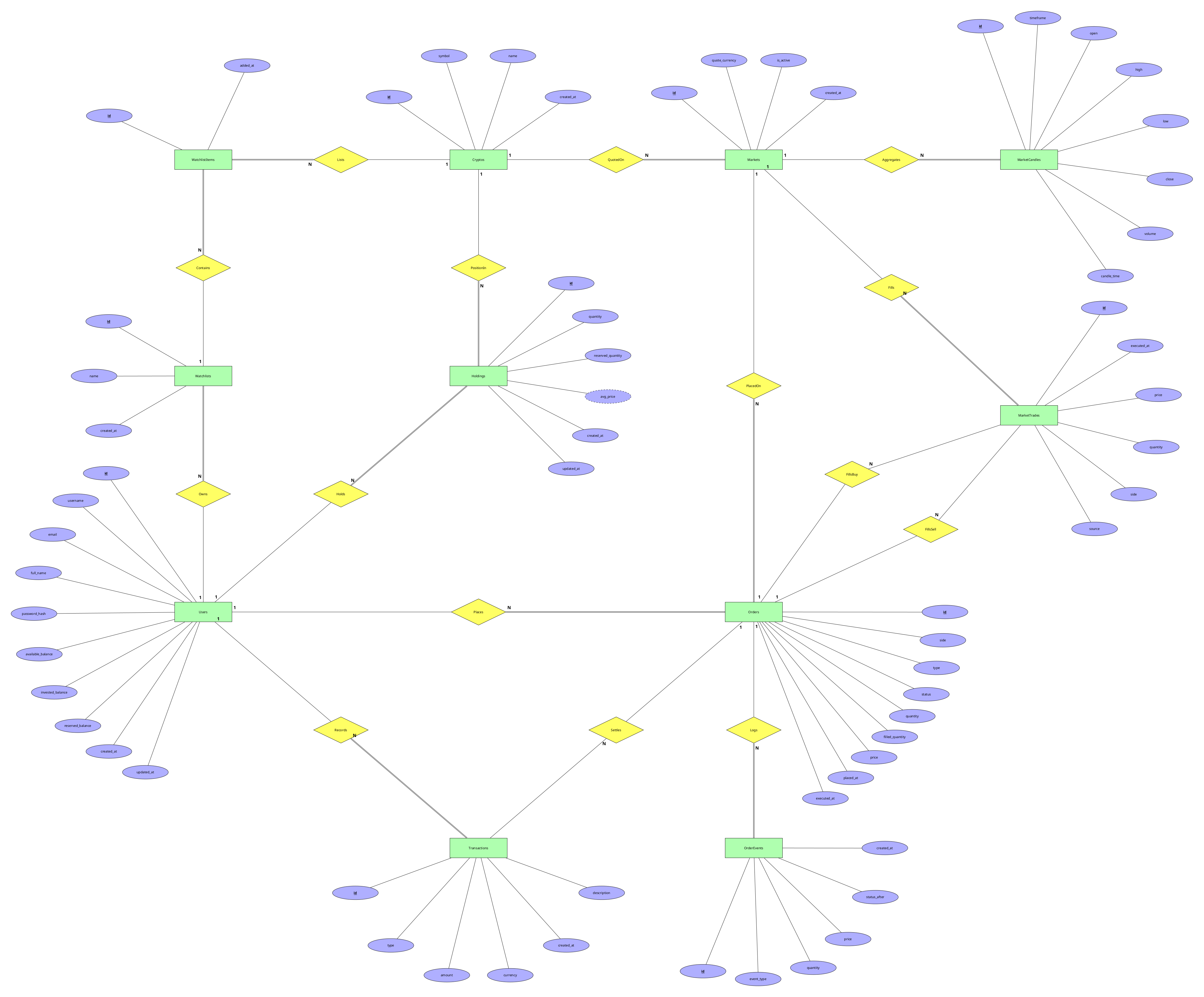
Diagram

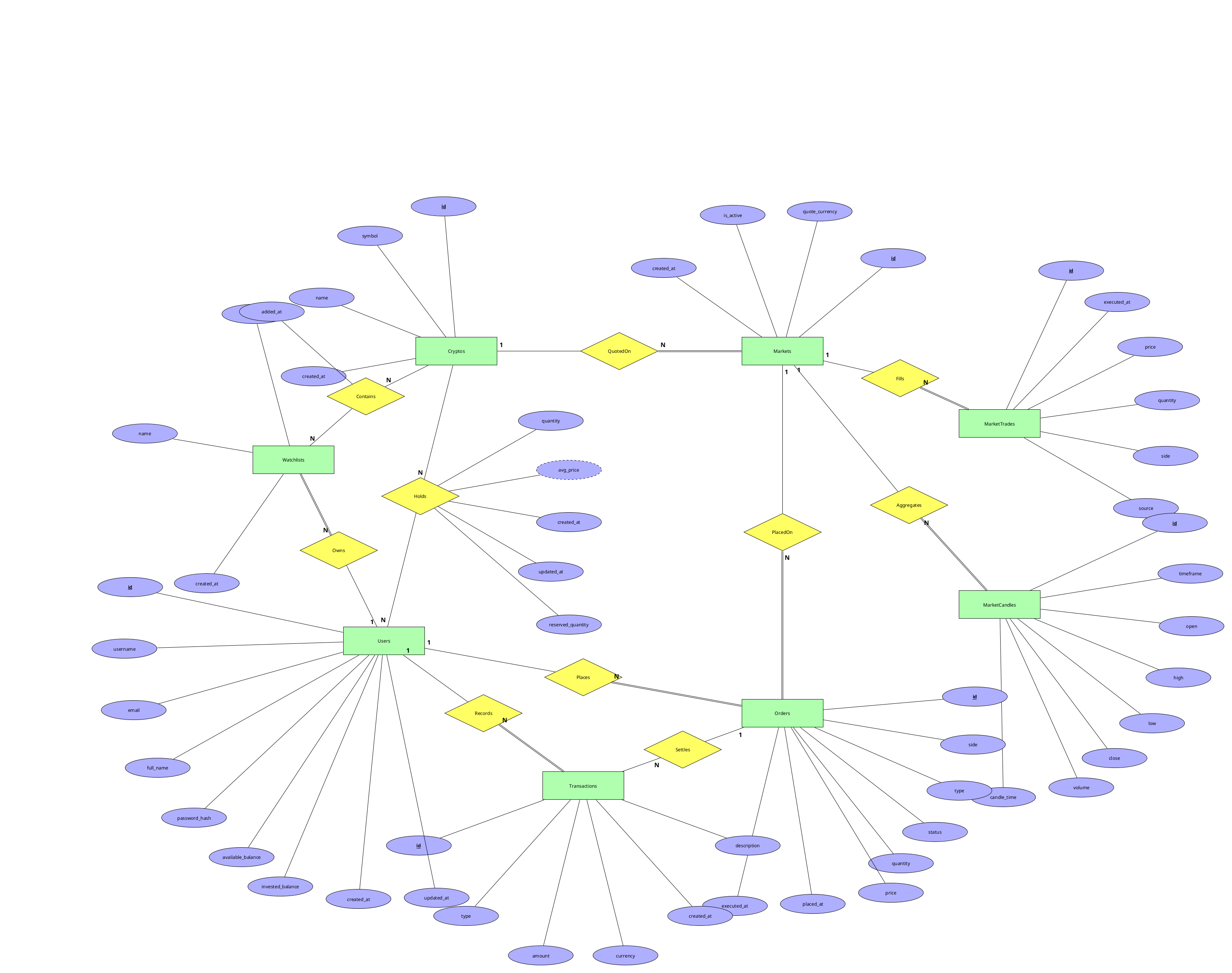
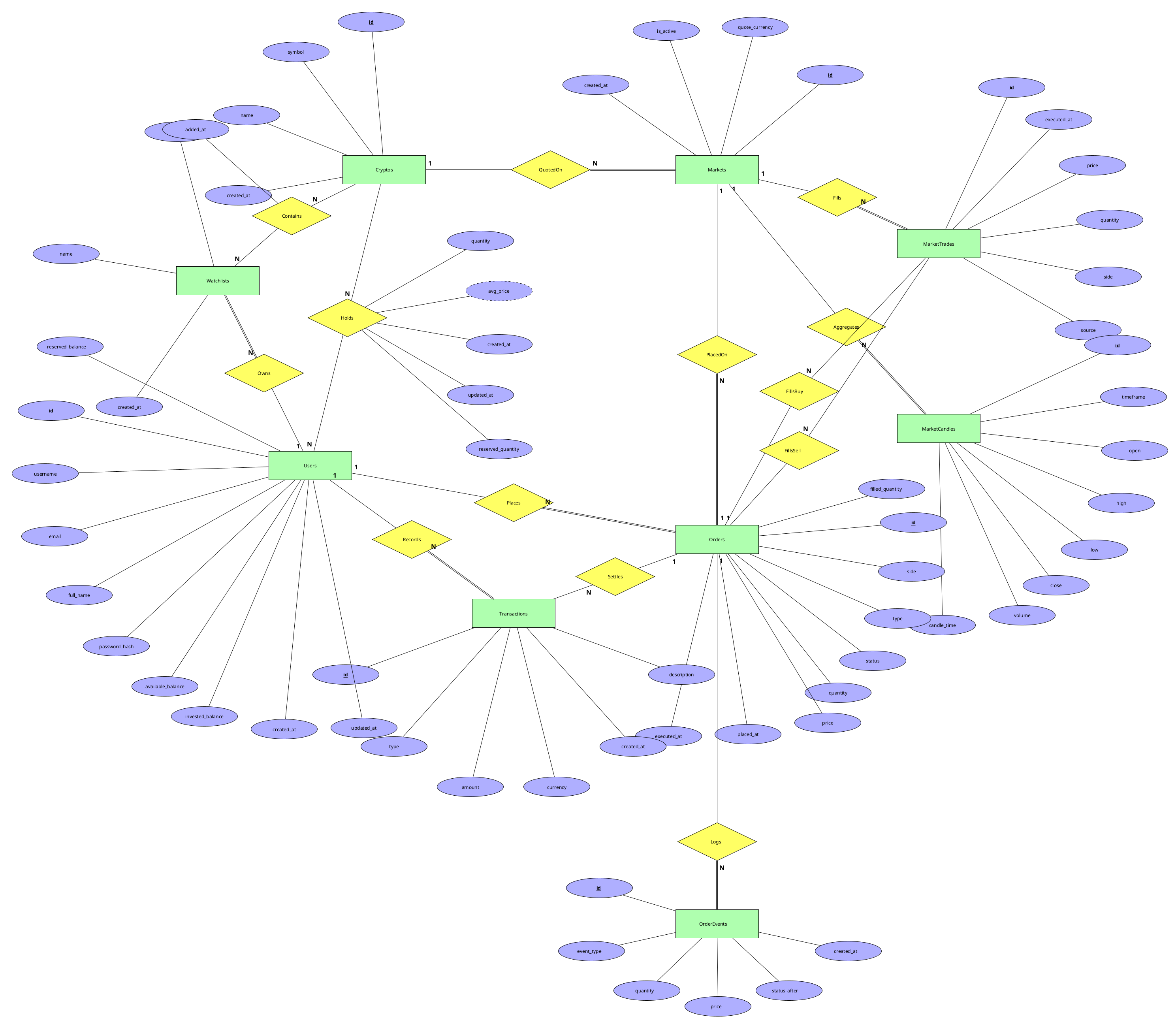
Notation: Chen. Rectangles are entity sets, diamonds are relationships, ellipses are attributes, underlined ellipses are primary keys, the dashed ellipse is a derived attribute. A double line between an entity set and a relationship marks total participation (every instance of that entity set must participate); a single line marks partial participation.
Three deliberate modeling decisions worth stating up front:
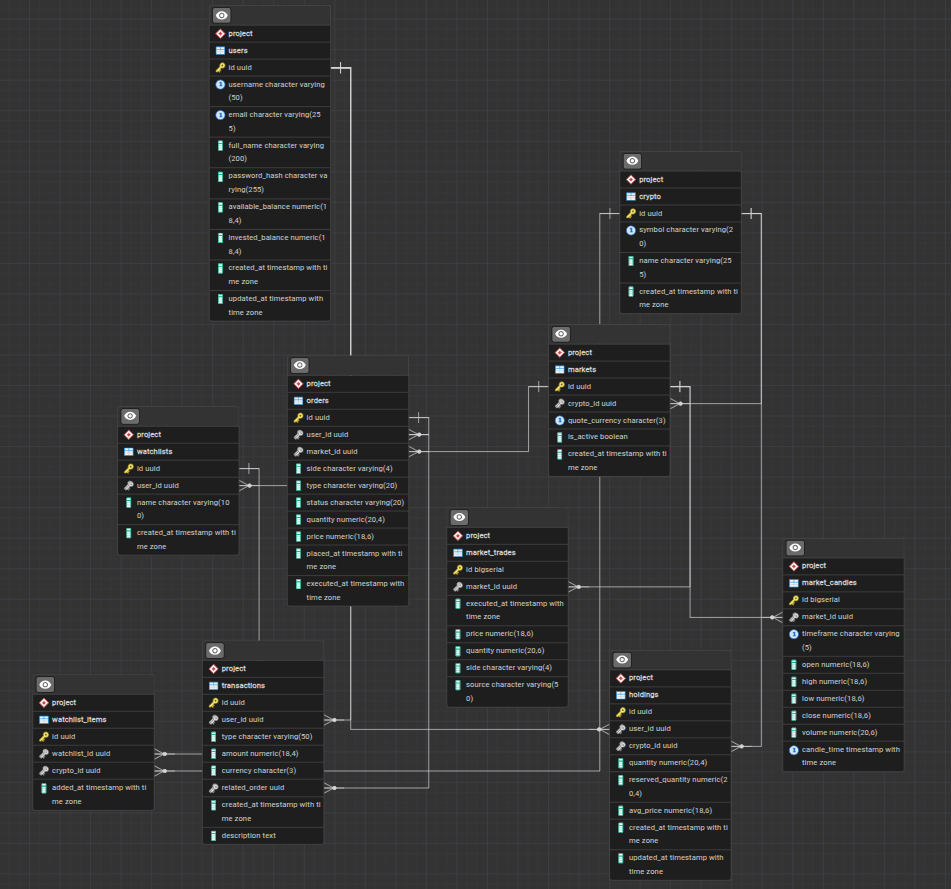
- No foreign keys appear in the diagram. Connections between entity sets are expressed as relationships, per the notation. Foreign-key columns appear only in the relational model in RelationalDesign.
- A position and a watchlist entry are entity sets, not M:N relationships.
Holdings(a user's position in an asset) andWatchlistItems(an asset on a watchlist) each have their own identifierid, and each is connected by two 1:N relationships:HoldsandPositionInfor a holding,ContainsandListsfor a watchlist item. Until v04 they were drawn as the M:N relationshipsHoldsandContains, but the database has always givenholdingsandwatchlist_itemstheir ownidprimary key. That is how an entity set is implemented, not an M:N relationship, whose key would be the pair of participating keys. v05 corrects the model to match; see history. - Key and uniqueness rules are stated with entity and relationship names, never with foreign-key columns. For example: "a crypto is quoted at most once per currency", not "
{crypto_id, quote_currency}is unique".
Data requirements
Each entity set is given as a short rationale for why it exists as its own set, its keys, and its attributes as a table. Each relationship is given as its cardinality and participation, a short rationale, and — where it carries data — an attribute table.
Entity sets
Users
Registered participants of the platform. Every action in the simulation is attributed to a user, and the two balance attributes are what makes the simulation work: cash that is free to trade is tracked separately from cash that is currently committed to open positions, so the platform can refuse a purchase without having to recompute the whole portfolio first.
Keys: candidates {id}, {username}, {email}; primary key id. A
surrogate UUID was chosen because it is opaque and stable — username and
email are both things a user may legitimately want to change later, and
every relationship in the diagram points at Users, so a mutable key would
propagate changes across the whole database.
| Attribute | Type | Constraints |
|---|---|---|
id | UUID | PK, required |
username | text(50) | required, unique |
email | text(255) | required, unique, contains @ (checked by the application at registration, not by a database constraint)
|
full_name | text(200) | optional |
password_hash | text(255) | required — never the password itself; the prototype stores a SHA-256 hex digest |
available_balance | numeric(18,4) | required, default 0, ≥ 0 |
invested_balance | numeric(18,4) | required, default 0, ≥ 0 |
reserved_balance | numeric(18,4) | required, default 0, ≥ 0 — cash set aside for the user's open buy orders (added in v04, after P7) |
created_at | timestamptz | required, defaults to now |
updated_at | timestamptz | optional (null until first change) |
Cryptos
The catalog of crypto assets the platform knows about. Kept separate from
Markets because an asset exists independently of the pairs it is traded in —
the same asset can be quoted against several currencies, and a user's holding is
in the asset, not in a particular pair.
Keys: candidates {id}, {symbol}; primary key id, for the same
reason as in Users. symbol is kept as a unique natural key because that is
what users type and see.
| Attribute | Type | Constraints |
|---|---|---|
id | UUID | PK, required |
symbol | text(20) | required, unique (e.g. BTC)
|
name | text(255) | required (e.g. Bitcoin)
|
created_at | timestamptz | required, defaults to now |
Markets
A tradeable pair: one crypto asset quoted in one currency, e.g. BTC/USD. This is
where prices live, and it is the thing an order is placed on. Modeled as its
own entity set rather than an attribute of Cryptos because a market has its own
lifecycle — it can be deactivated without deleting the asset — and because
trades, candles and orders all reference the pair, not the asset.
Keys: candidate {id}; primary key id, so that the many entity sets
related to a market need one narrow identifier instead of a composite one.
Uniqueness rule: a crypto is quoted at most once per currency, so the crypto
a market is QuotedOn together with its quote_currency identifies the market
as well. Chen notation cannot draw this, because half of it comes through a
relationship. P2 enforces it as UNIQUE(crypto_id, quote_currency).
| Attribute | Type | Constraints |
|---|---|---|
id | UUID | PK, required |
quote_currency | text(3) | required, default USD
|
is_active | boolean | required, default true — inactive markets are hidden from the trading menus but keep their history |
created_at | timestamptz | required, defaults to now |
Orders
A user's instruction to buy or sell on a market. Needed as a separate entity set because an order is a record of intent that outlives its execution: it keeps the requested quantity and price even after it has been filled, which is what makes the ledger auditable.
Placing an order is what triggers a reservation of whatever it commits:
the crypto being sold (Holdings.reserved_quantity, below) on a sell, and the
cash (Users.reserved_balance) on a buy. Since v04 (after P7) an order can
wait in the order book and be filled in parts, so status is a real
lifecycle driven by filled_quantity: open (nothing filled yet),
partially_filled, executed (completely filled), or cancelled, which
releases what is still reserved. See
UseCase0005 for the reserve-then-settle
sequence and
AdvancedDatabaseDevelopment
for the rules that keep it consistent.
Keys: candidate {id} only — there is no natural key, since the same user
can place two identical orders on the same market in the same second, and both
are legitimately distinct; primary key id.
| Attribute | Type | Constraints |
|---|---|---|
id | UUID | PK, required |
side | text | required, buy or sell
|
type | text | required, market or limit (both executed since P7)
|
status | text | required, open, partially_filled, executed or cancelled
|
quantity | numeric(20,4) | required, > 0 |
filled_quantity | numeric(20,4) | required, default 0, between 0 and quantity — how much has been traded; remaining = quantity − filled_quantity (added in v04, after P7)
|
price | numeric(18,6) | optional — the limit price; for a market order, the market price when it was placed |
placed_at | timestamptz | required, defaults to now |
executed_at | timestamptz | optional, set when the order settles |
Transactions
The financial ledger: every movement of virtual cash, in one place. This exists so that a balance is never just a number someone edited — it is the sum of an auditable list of entries, which is also what the "explain every step" goal of the project needs.
Keys: candidate {id} only; primary key id.
| Attribute | Type | Constraints |
|---|---|---|
id | UUID | PK, required |
type | text | required, deposit, buy, sell or fee
|
amount | numeric(18,4) | required, signed — negative for money leaving the cash balance, positive for money arriving |
currency | text(3) | required, default USD
|
created_at | timestamptz | required, defaults to now |
description | text | optional, free-form |
MarketTrades
Individual executed trades on a market, from the user's own fills and from the market simulator. This is the single source of truth for the current price: the price of a market is the price of its most recent trade, never a column someone writes directly.
Keys: candidate {id} — "market plus executed_at" looks unique in
principle, but two trades on a market can share a timestamp, so it is not a safe key;
primary key id (a plain auto-incrementing integer here rather than a
UUID, because this is the highest-volume entity set and it is only ever read
in timestamp order, never referenced by anything else).
| Attribute | Type | Constraints |
|---|---|---|
id | big integer | PK, required, auto-generated (bigserial in P2)
|
executed_at | timestamptz | required |
price | numeric(18,6) | required, > 0 |
quantity | numeric(20,6) | required, > 0 |
side | text | optional, buy or sell
|
source | text(50) | required, default simulation — distinguishes a simulated trade from a user's own fill (user)
|
Since v04 (after P7) a trade also records which orders it filled, through the
relationships FillsBuy and FillsSell below.
OrderEvents
Added in v04, after P7. The audit trail of an order: one event for its
placement, one for every (partial) fill, and one for a cancellation. The
Orders row only holds the current state; this entity keeps the history of
how the order got there. Events are recorded automatically by the database.
Keys: candidate {id} only; primary key id (auto-incrementing
integer, events are only read in order).
| Attribute | Type | Constraints |
|---|---|---|
id | big integer | PK, required, auto-generated (bigserial in P2)
|
event_type | text | required, placed, partially_filled, filled or cancelled
|
quantity | numeric(20,4) | required — the ordered quantity for placed, the filled amount for a fill, the unfilled rest for cancelled
|
price | numeric(18,6) | optional — the order price, or the trade price for a fill |
status_after | text | required, the order's status after the event |
created_at | timestamptz | required, set automatically when the event is recorded (clock_timestamp(), so events inside one transaction keep their real order)
|
MarketCandles
OHLCV aggregates per market and timeframe — the data a price chart is drawn from. Stored rather than computed on the fly because the point of the project is a chart-driven interface, and re-aggregating the whole trade history for every screen refresh does not scale.
Keys: candidate {id}; primary key id. Uniqueness rule: a market
has exactly one candle per timeframe per time bucket, so the market a candle
Aggregates together with timeframe and candle_time also identifies it.
This is the real-world constraint that prevents duplicate candles. P2 enforces
it as UNIQUE(market_id, timeframe, candle_time).
| Attribute | Type | Constraints |
|---|---|---|
id | big integer | PK, required, auto-generated (bigserial in P2)
|
timeframe | text | required, 1m, 5m, 1h or 1d
|
open, high, low, close | numeric(18,6) | all required |
volume | numeric(20,6) | required |
candle_time | timestamptz | required — the start of the bucket |
Watchlists
A named list of assets a user wants to monitor. A separate entity set rather than a flag on the relationship between users and assets, because a user may want several lists ("long term", "watching today") and each needs its own name.
Keys: candidate {id}; primary key id. "Owner plus name" would
also identify a list if names had to be unique per user, but the model does
not require that, so there is no uniqueness rule here.
| Attribute | Type | Constraints |
|---|---|---|
id | UUID | PK, required |
name | text(100) | required |
created_at | timestamptz | required, defaults to now |
Holdings
A user's position in one crypto asset: how much of it the user owns, how much
of that is already promised to open sell orders, and at what average price it
was accumulated. An entity set since v05 (until v04 it was the M:N
relationship Holds). A holding has its own identifier and its own
lifecycle: it is created on the first buy, updated on every later fill, and
the prototype reads and locks it as a unit (SELECT … FOR UPDATE on the sell
path). It is linked to its owner through Holds and to its asset through
PositionIn.
Keys: candidate {id}; primary key id. Uniqueness rule: a user
has at most one holding per crypto, so the user who Holds it together with
the crypto it is a PositionIn also identifies a holding. P2 enforces this as
UNIQUE(user_id, crypto_id).
reserved_quantity mirrors available_balance/invested_balance on Users:
two independently updated stored numbers, with the amount actually free to use
computed on demand rather than stored (quantity − reserved_quantity here,
available_balance alone on the cash side). Without it, nothing stopped a
user from placing a second sell order against crypto already promised to a
first one — quantity alone cannot tell "owned" apart from "owned, but
already committed elsewhere." See history, v03.
| Attribute | Type | Constraints |
|---|---|---|
id | UUID | PK, required |
quantity | numeric(20,4) | required, ≥ 0 — total amount owned |
reserved_quantity | numeric(20,4) | required, default 0, 0 ≤ reserved_quantity ≤ quantity — committed to the user's own open sell orders, not yet removed from the position
|
avg_price | numeric(18,6) | required, default 0, ≥ 0, derived (dashed ellipse) — the weighted average of the prices at which the position was accumulated; derivable from the buy history, stored anyway so unrealised P/L can be shown without replaying the whole ledger |
created_at | timestamptz | required, defaults to now |
updated_at | timestamptz | optional |
WatchlistItems
One asset placed on one watchlist. An entity set since v05 (until v04 it was
the M:N relationship Contains). It has its own identifier, and it is linked
to its list through Contains and to its asset through Lists.
Keys: candidate {id}; primary key id. Uniqueness rule: an asset
appears at most once on a given list, so the watchlist that Contains an item
together with the crypto it Lists also identifies the item. P2 enforces this
as UNIQUE(watchlist_id, crypto_id).
| Attribute | Type | Constraints |
|---|---|---|
id | UUID | PK, required |
added_at | timestamptz | required, defaults to now — recorded so a list can be shown in the order the user built it |
Relationships
QuotedOn — Cryptos (1) : Markets (N), total on Markets
Ties a market to the asset it trades. One asset can be quoted in many markets;
every market must have exactly one asset, hence total participation on the
Markets side. No attributes.
PlacedOn — Markets (1) : Orders (N), total on Orders
Records which market an order was placed on. Every order must name a market; a market may have no orders yet. No attributes.
Places — Users (1) : Orders (N), total on Orders
Records who placed an order. Every order belongs to exactly one user; a new user has no orders. No attributes.
Records — Users (1) : Transactions (N), total on Transactions
Attributes each ledger entry to a user. Every entry belongs to exactly one user. No attributes.
Settles — Orders (1) : Transactions (N), partial on both sides
Links a ledger entry to the order that caused it. Partial on the
Transactions side because deposits have no originating order, and partial on
the Orders side because an order that never executes never produces a
ledger entry — which is why the corresponding column is nullable in P2. No
attributes.
Fills — Markets (1) : MarketTrades (N), total on MarketTrades
Every executed trade happened on exactly one market. No attributes.
FillsBuy — Orders (1) : MarketTrades (N), partial on both sides
Added in v04, after P7. The buy order a trade filled. An order can be
filled by many trades (partial fills); a trade fills at most one buy order,
and none when the simulated market was the buyer. The role of Orders in this
relationship is the buy order of the trade. No attributes.
FillsSell — Orders (1) : MarketTrades (N), partial on both sides
Added in v04, after P7. The sell order a trade filled, symmetric to
FillsBuy; the role of Orders here is the sell order of the trade. A
trade between two users' orders participates in both. No attributes.
Logs — Orders (1) : OrderEvents (N), total on OrderEvents
Added in v04, after P7. Every event belongs to exactly one order. No attributes.
Aggregates — Markets (1) : MarketCandles (N), total on MarketCandles
Every candle summarises trades of exactly one market. No attributes.
Owns — Users (1) : Watchlists (N), total on Watchlists
Every watchlist belongs to exactly one user. No attributes.
Holds — Users (1) : Holdings (N), total on Holdings
1:N since v05. Every holding belongs to exactly one user. A user may hold
nothing yet, so participation is partial on the Users side. No attributes.
PositionIn — Cryptos (1) : Holdings (N), total on Holdings
Added in v05. Every holding is a position in exactly one crypto asset. An asset may be held by nobody. No attributes.
Together, Holds and PositionIn still say what the old M:N Holds said:
a user can hold many assets and an asset can be held by many users. The
difference is that the position is now a thing with its own identity, not
just a pair. The rule "at most one holding per user and crypto" is stated
under Holdings.
Contains — Watchlists (1) : WatchlistItems (N), total on WatchlistItems
1:N since v05. Every watchlist item is on exactly one list. An empty list is
valid, so participation is partial on the Watchlists side. No attributes.
Lists — Cryptos (1) : WatchlistItems (N), total on WatchlistItems
Added in v05. Every watchlist item names exactly one crypto asset. An asset need not be on any list. No attributes.
Entity-Relationship Model History
- v01 — First complete version. Built from the entity notes in
ep-diagram.md(the initial hand-written model), with three changes made to that initial model while drawing it:Marketswas promoted from an implied attribute of the asset to its own entity set, so that prices, orders, trades and candles can all reference a pair rather than an asset.holdingsandwatchlist_itemswere re-expressed as the M:N relationshipsHoldsandContainswith their own attributes, instead of entity sets with foreign keys — the initial notes listed them as tables, which is a relational concept that does not belong in a Chen ERD.avg_pricewas marked as a derived attribute rather than a plain one, to make the denormalisation explicit rather than hidden.
- v02 — Student review pass over the AI-generated v01 in the TerraER GUI.
- v03 — Added
reserved_quantitytoHolds, and rewordedOrders.statusto state its reserve → settle → (cancel) lifecycle explicitly, instead of leavingopen/cancelledas unused enum values. Triggered by a design review that pointed out the model had no way to stop a user from placing a second sell order against crypto already promised to a first, unsettled one —quantityalone cannot distinguish "owned" from "owned, but already committed." Also redrawn more compactly: every entity and relationship (with its own attributes moved along with it) was pulled proportionally toward the diagram's centroid, shrinking the canvas by roughly 45% with the same topology and no new overlaps. See ERModelAIUsage for the reasoning and how the diagram file itself was produced, and RelationalDesign and UseCase0005 for how the new attribute is enforced. - v04 — after P7. Phase 7 (order, balance and trade consistency) needed data the model did not have, so the model was extended to stay in line with the database:
Users.reserved_balance: cash reserved by open buy orders;Orders.filled_quantityand the status valuepartially_filled: orders can now be filled in parts;- the relationships
FillsBuyandFillsSellbetweenOrdersandMarketTrades: which orders a trade filled; - the entity set
OrderEventswith the relationshipLogs: the automatically recorded history of every order.
Nothing existing was removed or changed. See AdvancedDatabaseDevelopment. The diagram files are
ERModel_v04.xml/ERModel_v04.png.
- v05 — correction after review. The review of P2 found that two parts of the model were implemented differently in the database:
Containswas an M:N relationship in the model, butwatchlist_itemshas its ownidprimary key;Holdswas an M:N relationship in the model, butholdingshas its ownidprimary key.
An M:N relationship has no identifier of its own; its table's key is the pair of participating keys. A table with its own
idis the implementation of an entity set. Every phase after P2 (the prototype, the reports and the P7 logic) already uses the database as it is. So the model was corrected to match P2, not the other way round:
Holds(M:N, with attributes) became the entity setHoldings(its former attributes plusid) with two 1:N relationships,Holds(Users → Holdings) andPositionIn(Cryptos → Holdings), both total on theHoldingsside;Contains(M:N, withadded_at) became the entity setWatchlistItems(id,added_at) withContains(Watchlists → WatchlistItems) andLists(Cryptos → WatchlistItems), both total on theWatchlistItemsside;- the former keys of the two relationships are kept as uniqueness rules ("one holding per user and crypto", "an asset at most once per list");
- the key descriptions of
Markets,MarketTrades,MarketCandlesandWatchlistsno longer name foreign-key columns (crypto_id,market_id,user_id), which do not exist in an ER model; - the diagram was redrawn on a grid with no overlapping attributes. In v04,
Watchlists.idwas hidden behindadded_at, and several attributes ofOrders,Transactions,MarketTradesandMarketCandlesoverlapped. The grid also makes it easier to compare the diagram with the P2 relational diagram.
The diagram files are
ERModel_v05.xml/ERModel_v05.png; earlier versions are kept.
Reasoning for the AI-assisted part of this phase, and the full interaction log, are on ERModelAIUsage.
Attachments (4)
- relational_schema_v2.png (208.0 KB ) - added by 6 days ago.
-
ERModel_v03.png
(435.7 KB
) - added by 6 days ago.
Model
- ERModel_v04.png (579.6 KB ) - added by 6 days ago.
- ERModel_v05.png (629.1 KB ) - added by 15 hours ago.
Download all attachments as: .zip