| Version 16 (modified by , 5 months ago) ( diff ) |
|---|
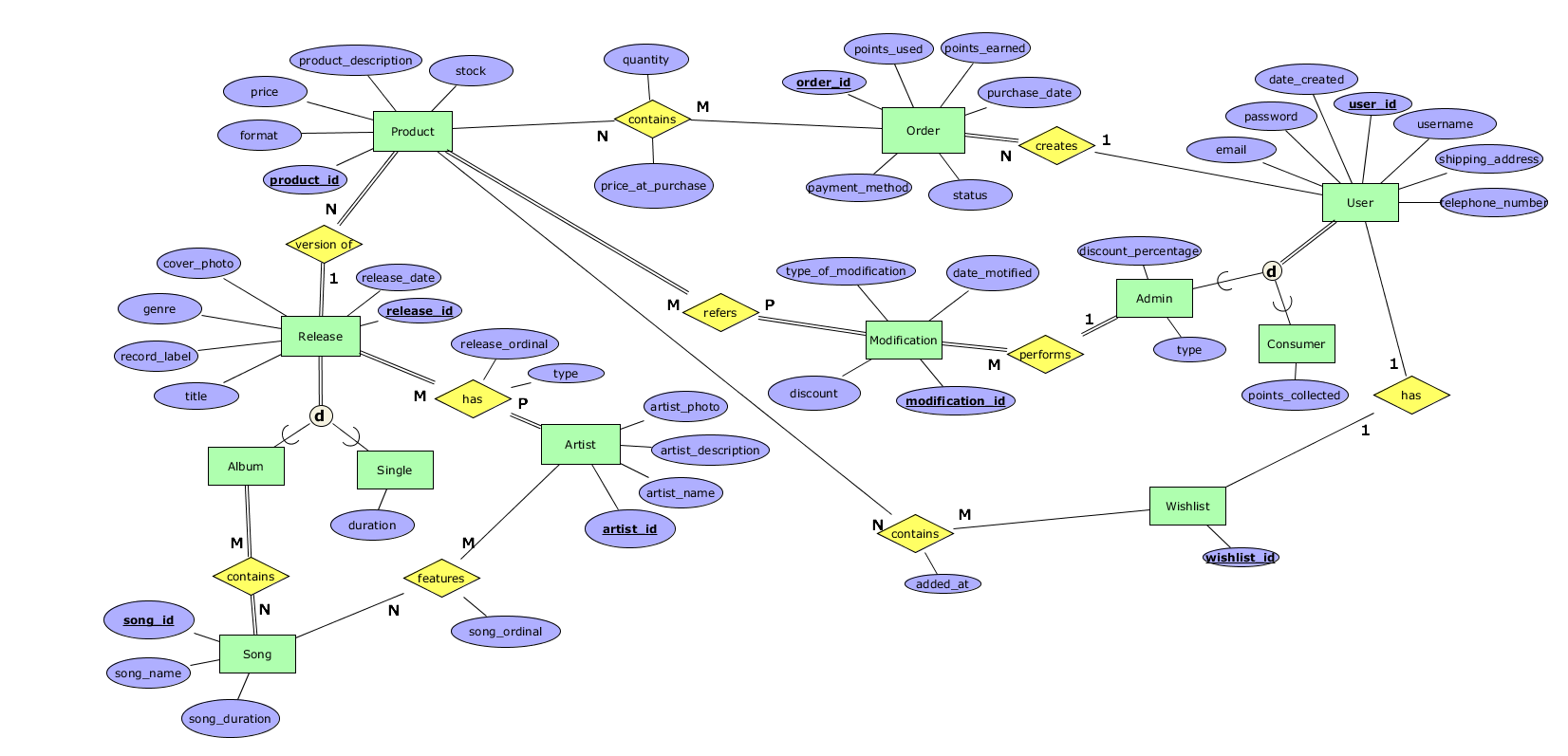
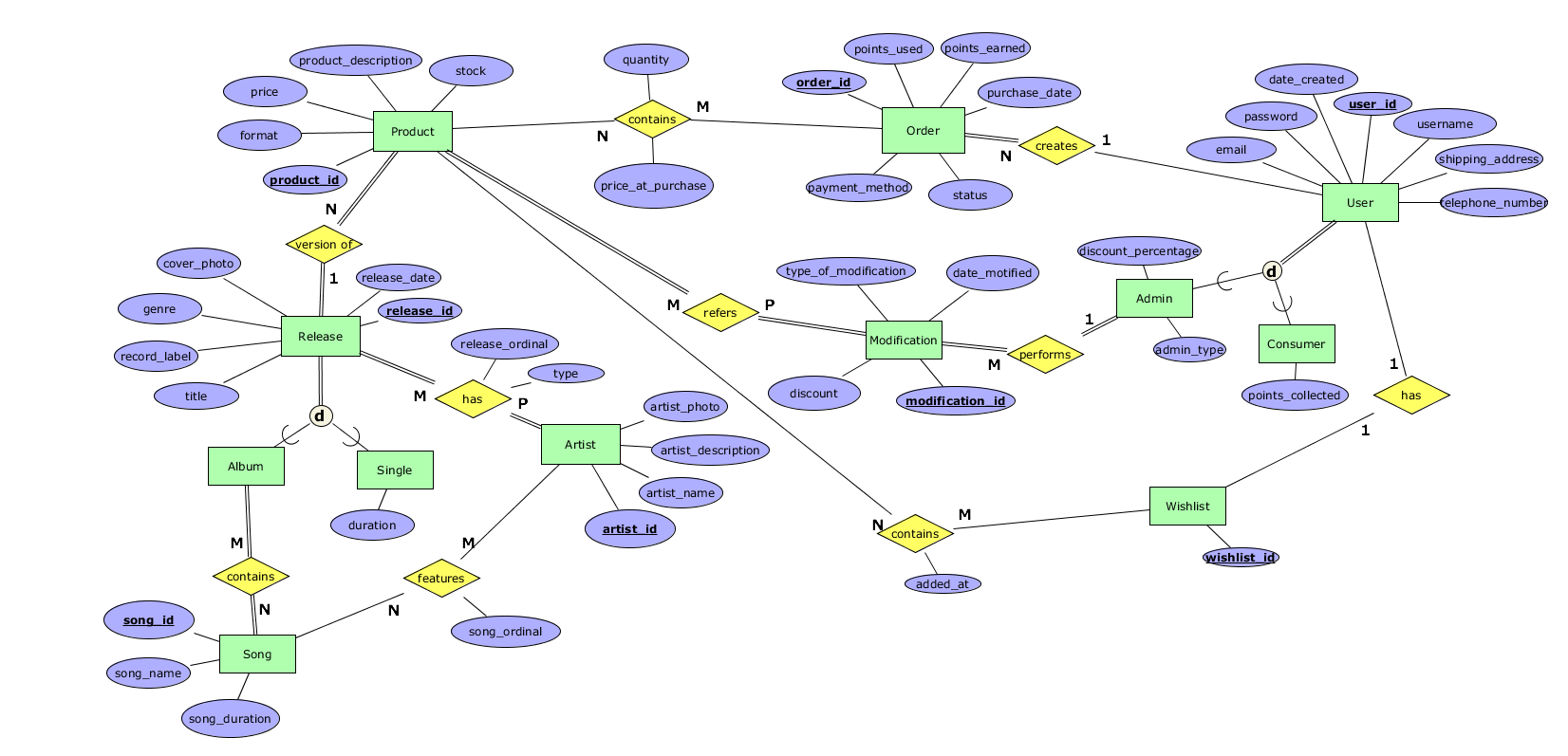
Entity-Relationship Model

Entities
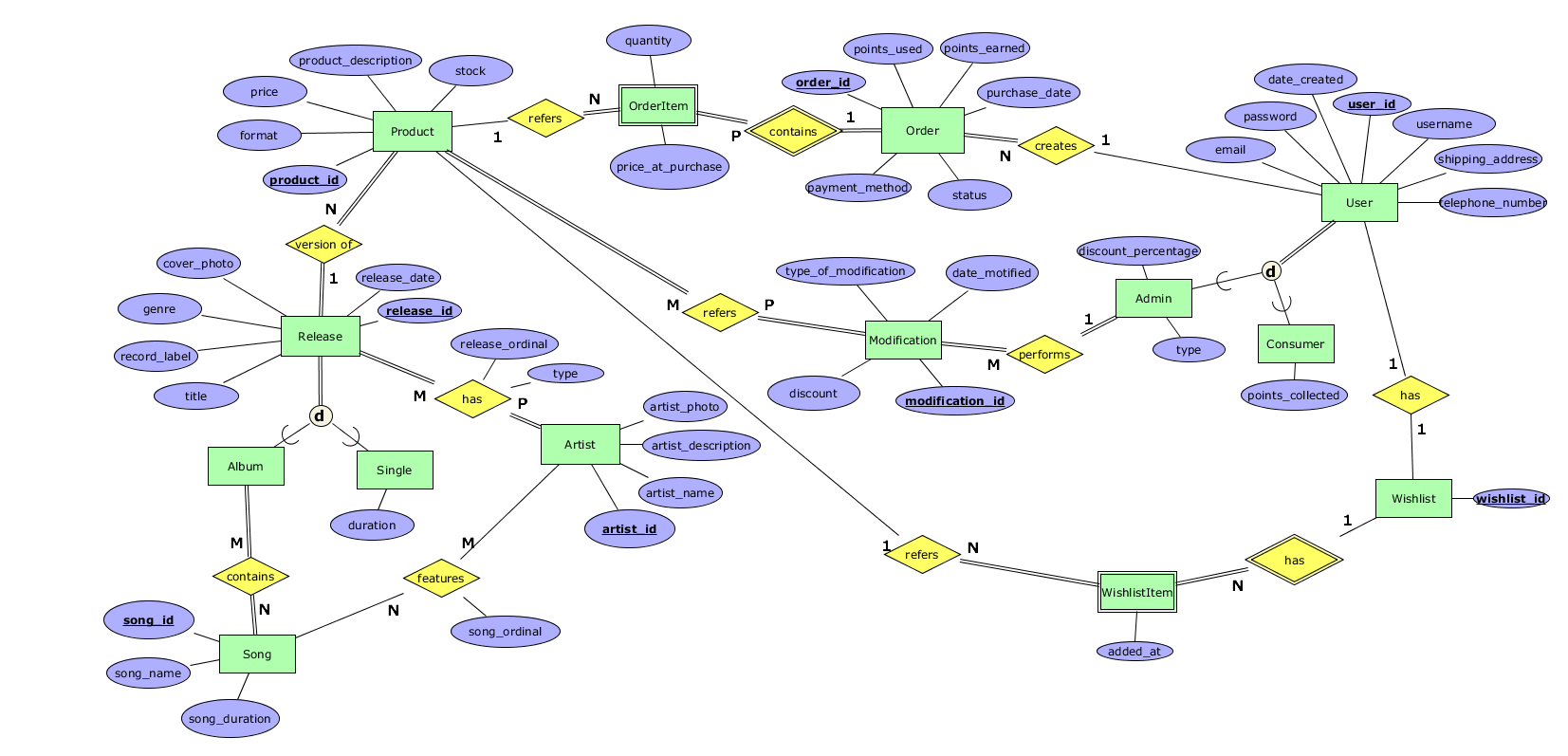
1. User - Represents any registered person in the system with personal information
- user_id (bigint)
- email (text, required, unique)
- username (text, required, unique)
- password (text, required)
- date_created (date, required)
- shipping_address (text, optional)
- telephone_number (text, optional)
2. Admin - A type of user responsible for managing products and performing modifications
- user_id* (bigint)
- type (enum, required)
- discount_percentage (numeric, required)
3. Consumer - A type of user who can purchase products and collect loyalty points
- user_id* (bigint)
- points_collected (bigint, required)
4. Wishlist - A collection of products that a user saves for future interest
- wishlist_id (bigint)
5. WishlistItem - A specific product added to a wishlist
- wishlist_id* (bigint)
- product_id* (bigint)
- added_at (date, required)
6. Product - A purchasable item with price, stock, and format
- product_id (bigint)
- format (enum, required)
- price (numeric, required)
- description (text, required)
- stock (bigint, required)
7. Release - A musical work that groups different product formats
- release_id (bigint)
- title (text, required)
- record_label (text, optional)
- genre (text, required)
- release_date (date, required)
- cover_photo (text, required)
8. Album - A type of release consisting of multiple songs
- release_id* (bigint)
9. Single - A type of release typically representing a single track
- release_id* (bigint)
- duration (text, required)
10. Artist - A creator or performer associated with releases and songs
- artist_id (bigint)
- artist_name(text, required)
- description(text, optional)
- photo (text, optional)
11. Song - An individual track that can belong to albums
- song_id (bigint)
- song_name(text, required)
- duration (text, required)
12. OrderItem - A specific product entry within an order
- order_id* (bigint)
- product_id* (bigint)
- price_at_purchase (numeric, required)
- quantity (bigint, required)
13. Order - A transaction made by a user containing purchased products
- order_id (bigint)
- payment_method (enum, required)
- purchase_date (date, required)
- points_earned (bigint, required)
- points_used (bigint, optional)
- status (enum, required)
14. Modification - An action performed by an admin that changes or creates one or more products
- modification_id (bigint)
- date_modified (date, required)
- type_of_modification(enum, required)
- discount (numeric, optional)
Relationships
1. contains (Album ↔ Song, M:N)
Each Album contains Songs, while the same Song can be in multiple albums.
2. has (Release ↔ Artist, M:N)
Each Artist has multiple Releases, and multiple Artists can be associated with one Release.
3. features (Song ↔ Artist, M:N)
Each Song can feature multiple Artists, and each Artist can be featured in multiple Songs.
4. version_of (Product ↔ Release, N:1)
Each Product represents a specific format of one Release, while a Release can have multiple Products.
5. refers (OrderItem ↔ Product, N:1)
Each OrderItem refers to one Product, while a Product can appear in multiple OrderItems.
6. contains (Order ↔ OrderItem, 1:N)
Each Order contains multiple OrderItems, while each OrderItem belongs to exactly one Order.
7. creates (User ↔ Order, 1:N)
Each User can create multiple Orders, while each Order is created by exactly one User.
8. modifies (Admin ↔ Modification, 1:N)
Each Admin can perform multiple Modifications, while each Modification is performed by exactly one Admin.
9. refers (Modification ↔ Product, M:N)
Each Modification can affect multiple Products, while each Product can be affected by multiple Modifications.
10. has (User ↔ Wishlist, 1:1)
Each User has exactly one Wishlist, and each Wishlist belongs to exactly one User.
11. has (Wishlist ↔ WishlistItem, 1:N)
Each Wishlist contains multiple WishlistItems, while each WishlistItem belongs to exactly one Wishlist.
12. refers (WishlistItem ↔ Product, N:1)
Each WishlistItem refers to one Product, while a Product can appear in multiple WishlistItems.
Entity-Relationship Model History
Attachments (12)
- ERModel_v01.xml (47.7 KB ) - added by 5 months ago.
- ERModel_v01.png (185.9 KB ) - added by 5 months ago.
- ERModel_v02.png (176.6 KB ) - added by 5 months ago.
- ERModel_v02.xml (46.5 KB ) - added by 5 months ago.
- ERModel_v03.png (171.6 KB ) - added by 5 months ago.
- ERModel_v03.xml (53.4 KB ) - added by 5 months ago.
- ERModel_v04.xml (50.8 KB ) - added by 4 months ago.
- ERModel_v04.png (168.9 KB ) - added by 4 months ago.
- ERModel_v05.xml (47.4 KB ) - added by 4 months ago.
- ERModel_v05.png (159.9 KB ) - added by 4 months ago.
- ERModel_v06.png (160.2 KB ) - added by 5 weeks ago.
- ERModel_v06.xml (47.4 KB ) - added by 5 weeks ago.
Download all attachments as: .zip