| Version 4 (modified by , 5 months ago) ( diff ) |
|---|
Entity-Relationship Model v.02
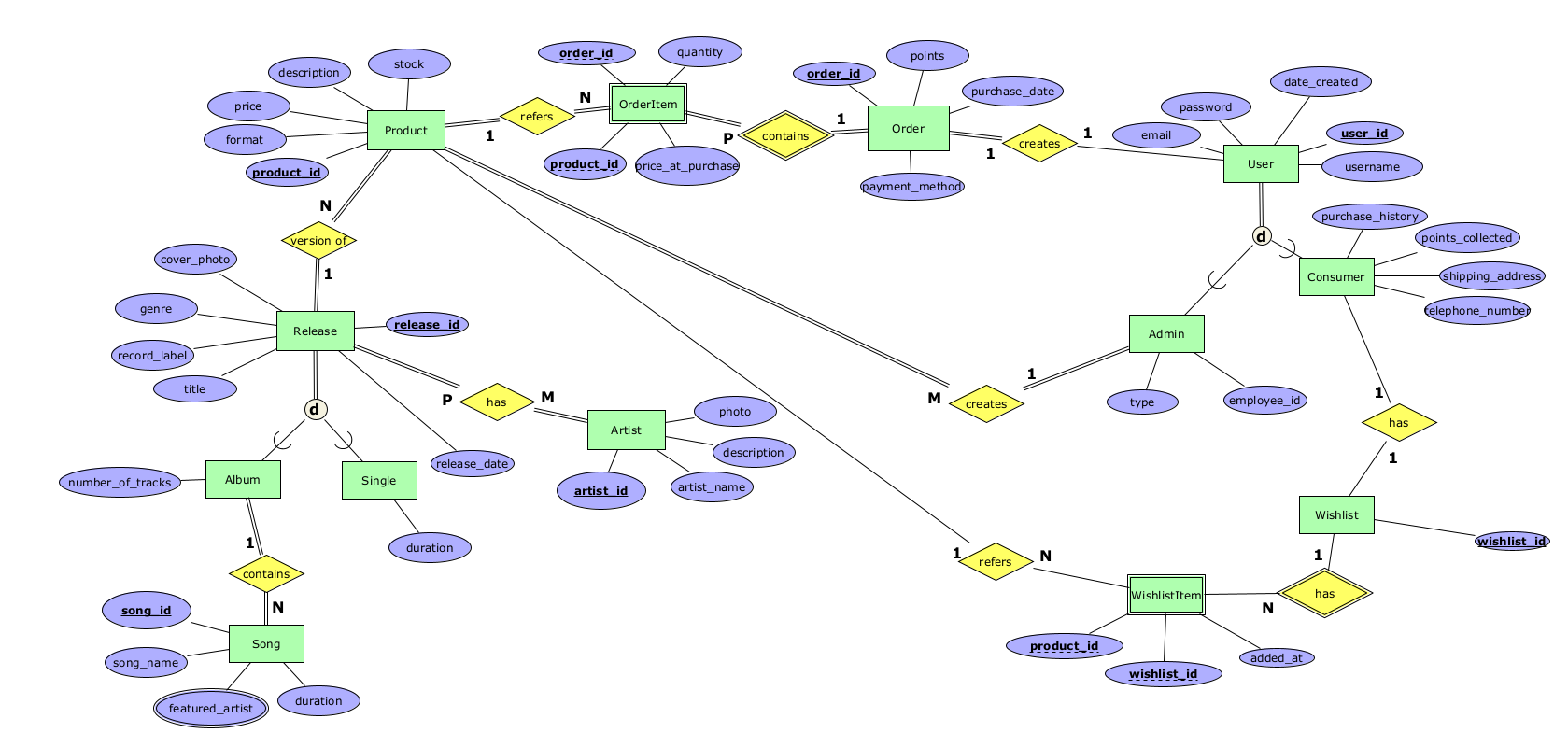
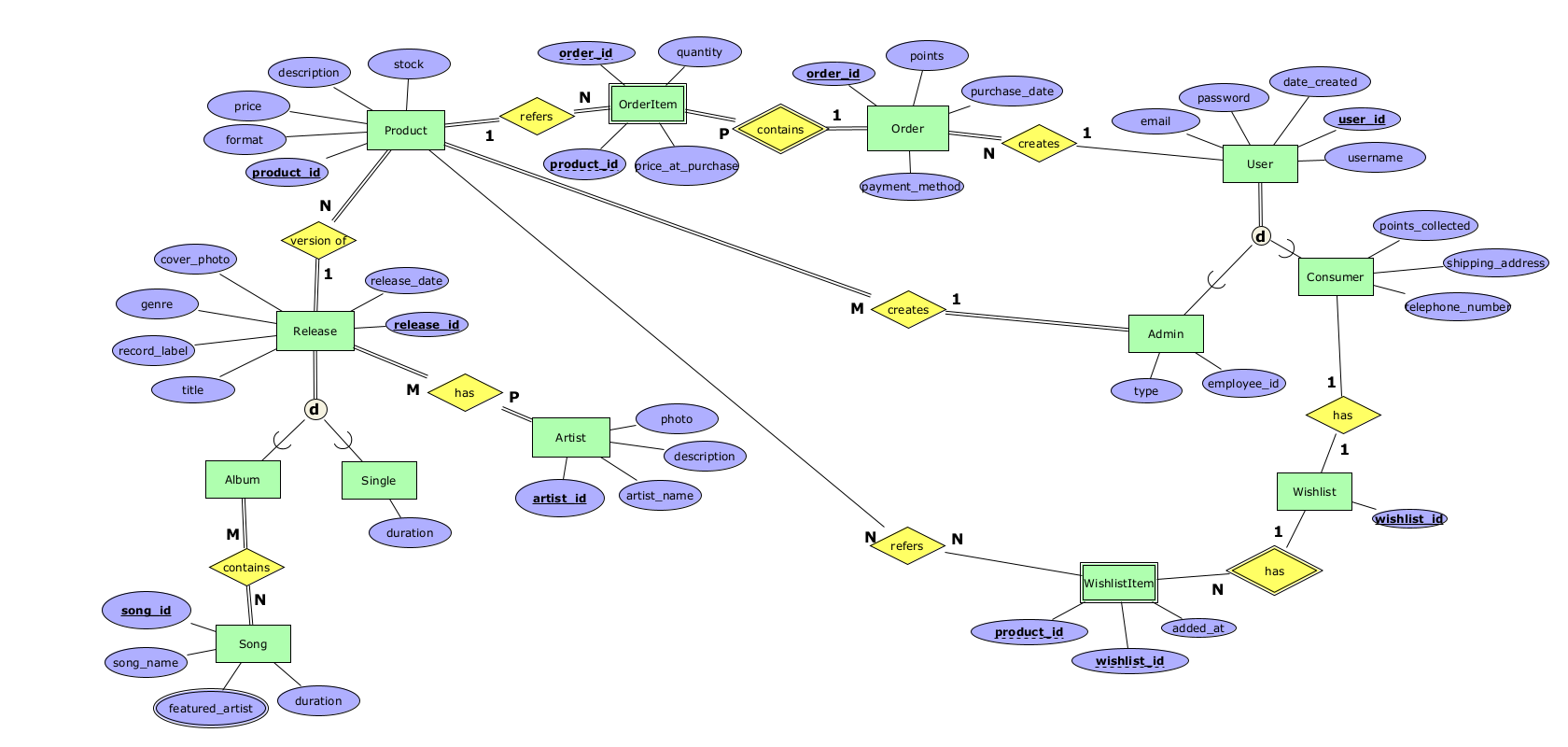
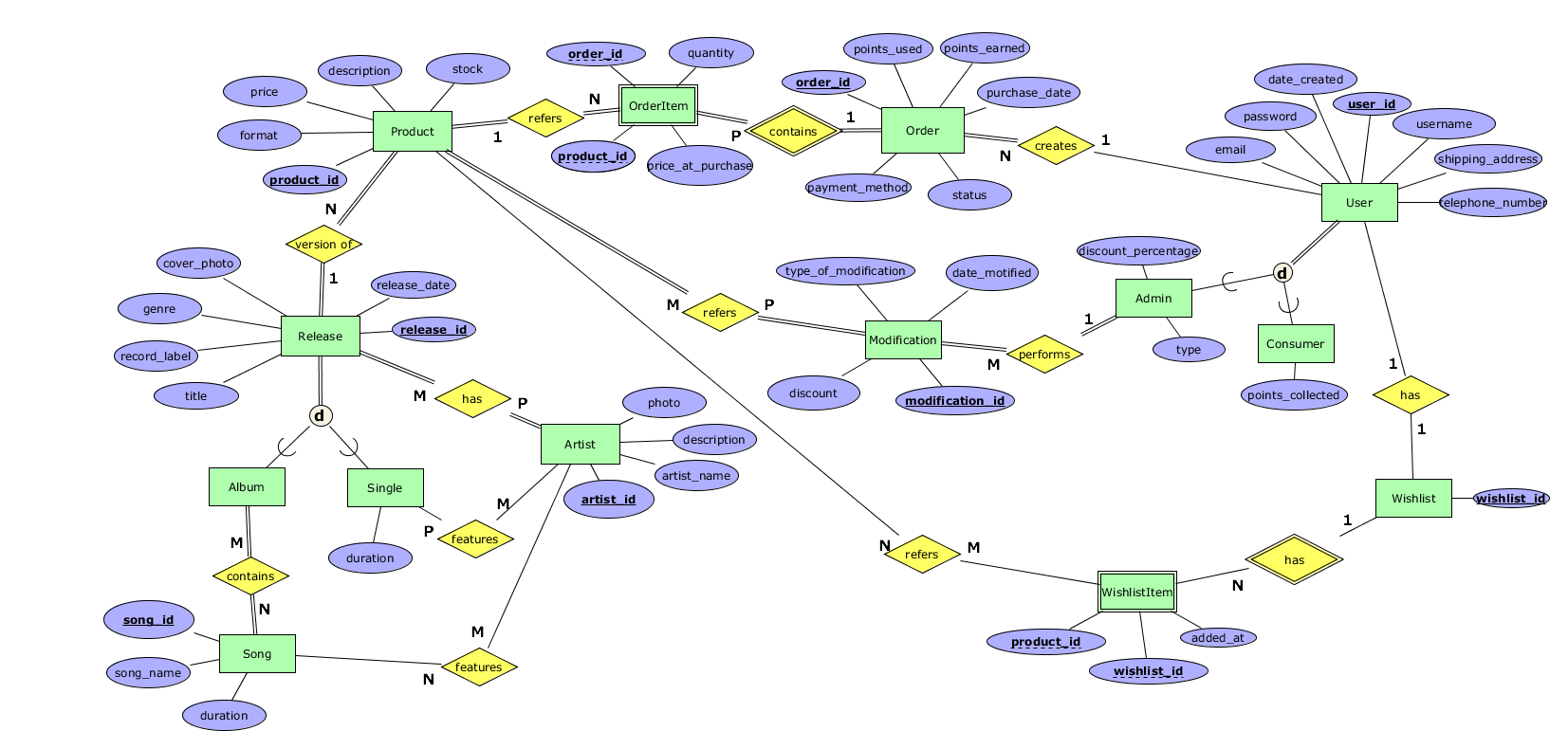
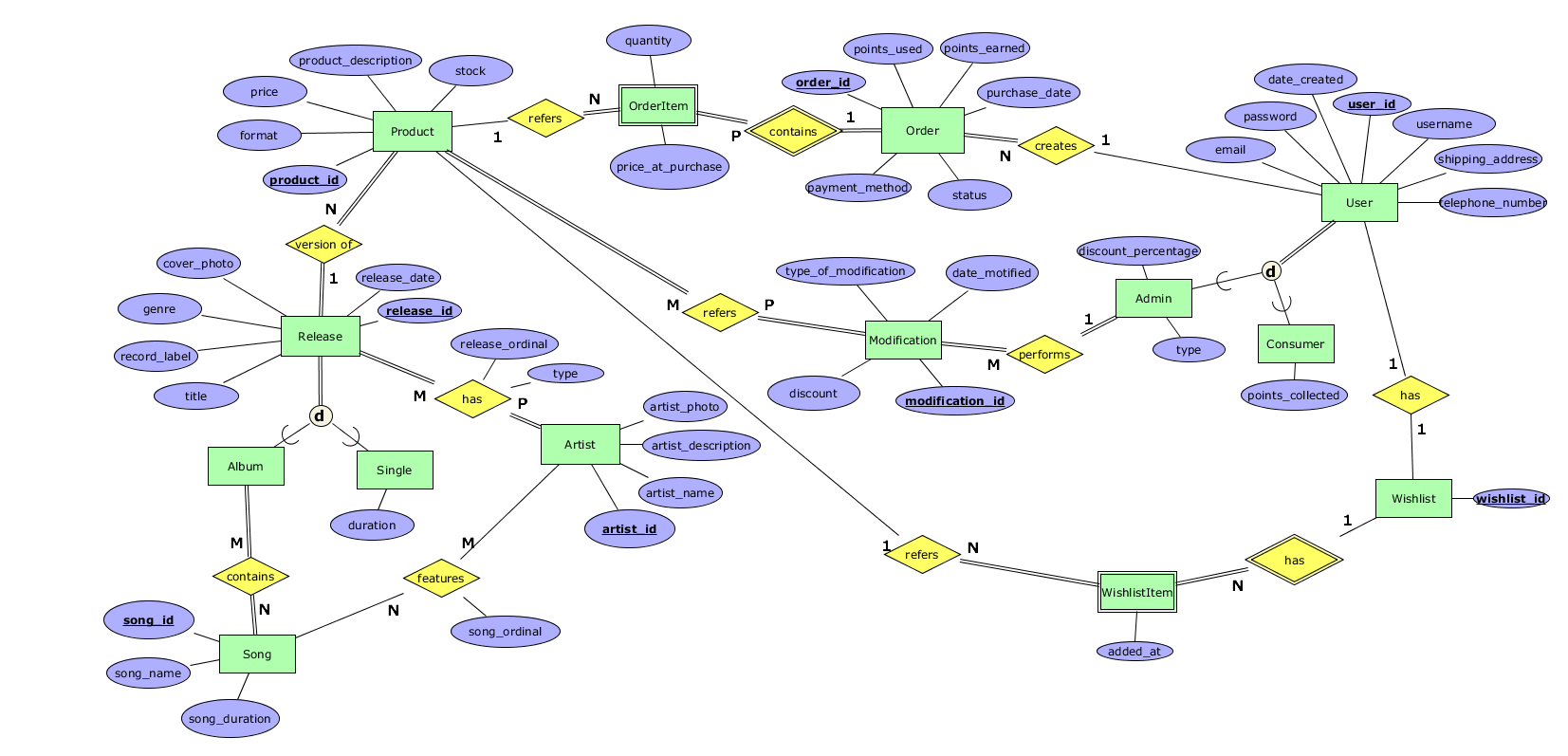
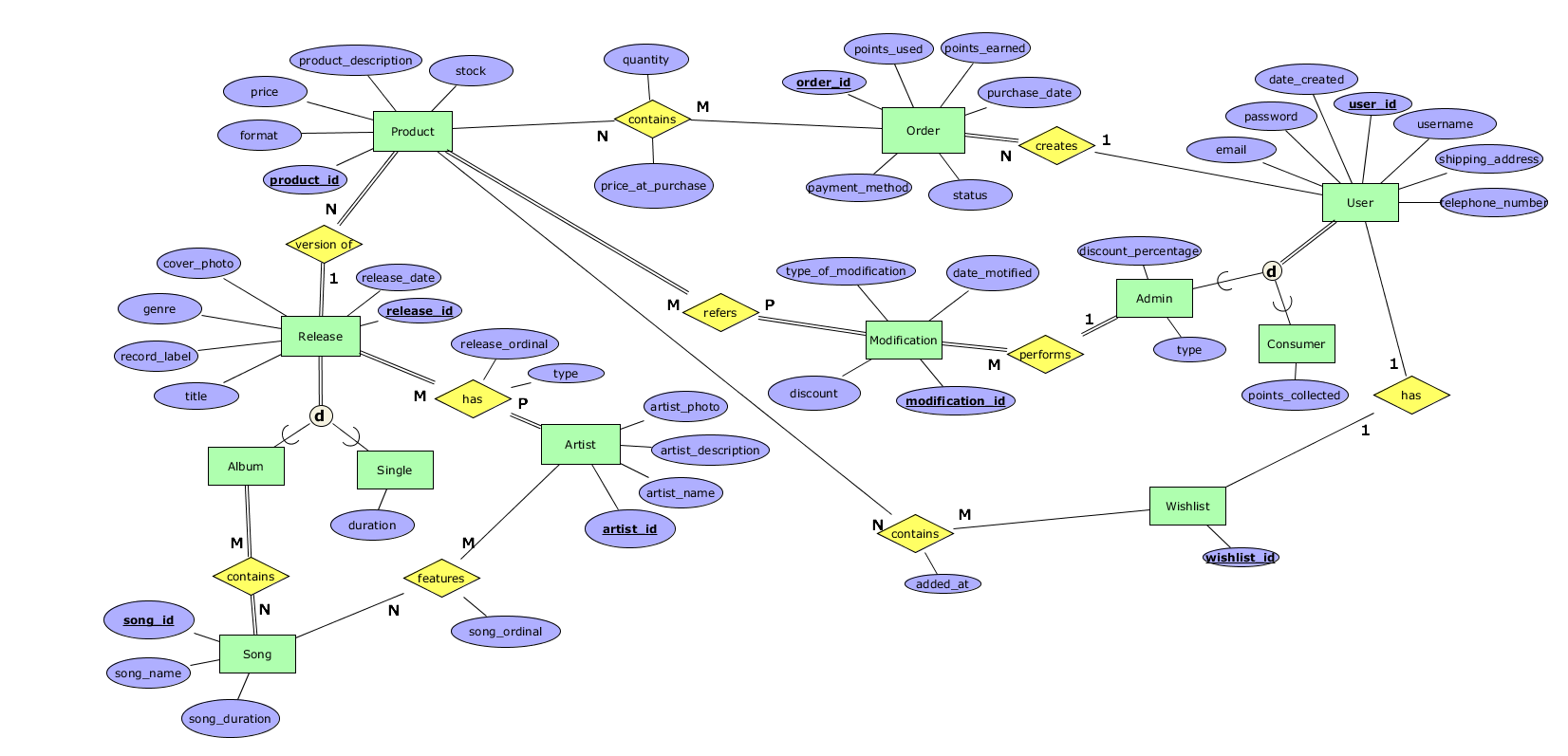
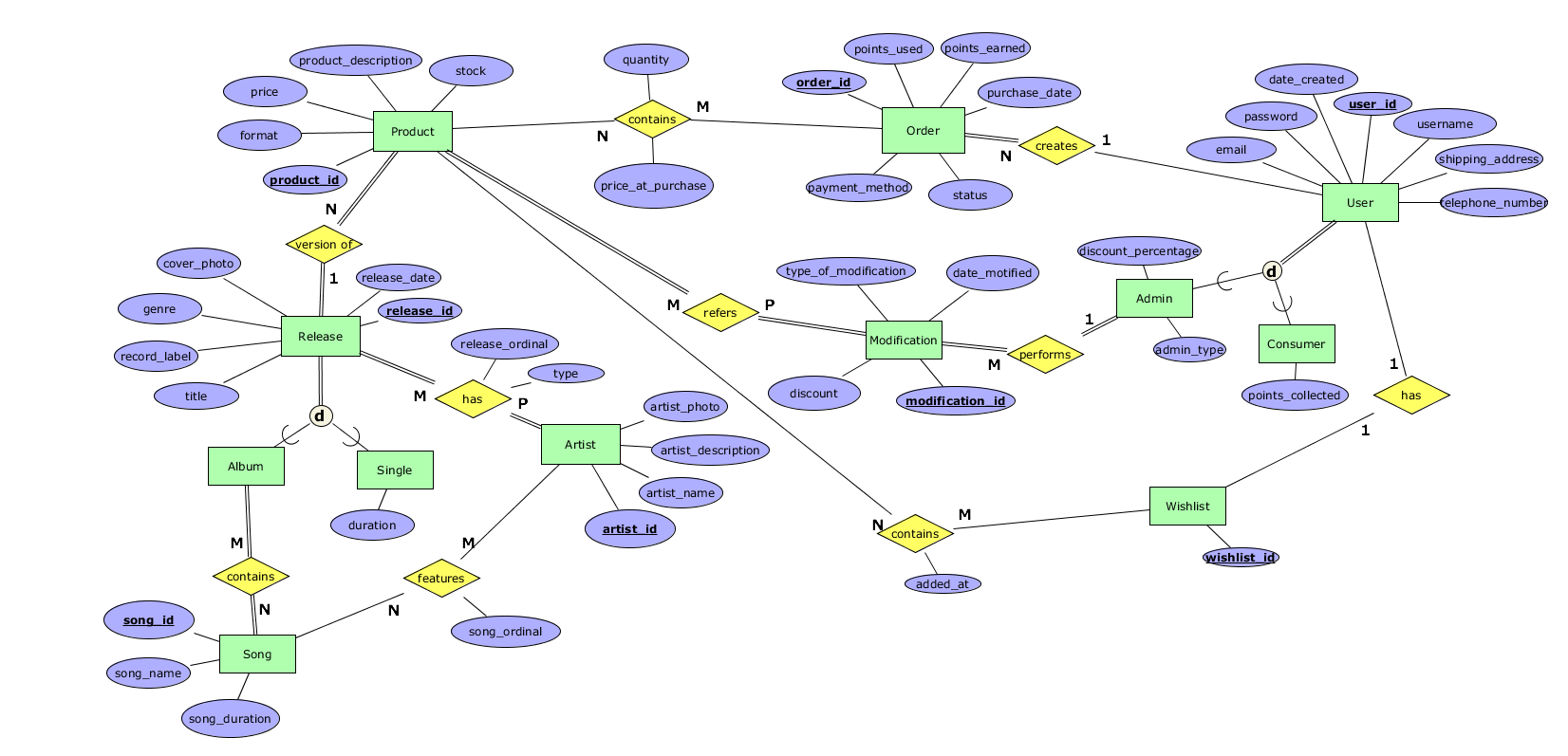
A full-page width image in PNG format of the latest version of the diagram (ERModel_vNN.png)
Entities
List all entities and relationships with the following information for each of them
Entity/relationship name: one paragraph of explanation, what does the entity/relationship represent, why it is needed, why is it modeled the way it is
Candidate keys: If you have multiple candidates for the primary key, list them and explain which one you chose as the primary key and why you chose it as the primary key
List of entity attributes, for each of them: the data type (numeric/text/date/…) and whether there are any restrictions in the input form/format (required/optional, special format, value interval, …)
NAME OF ENTITY/RELATIONSHIP
DESCREPTION OF THE ENTITY/RELATIONSHIP
- 1.User:
- user_id (bigint) - primary key
- email (text)
- username (bigint)
- password (bigint)
- date_created (date)
- 2.Admin:
- type (text)
- employee_id (bigint)
- 3.Consumer:
- telephone_number (text)
- shipping_address (text)
- points_collected (bigint)
- 4.Wishlist:
- wishlist_id (bigint) - primary key
- 5.WishlistItem:
- wishlist_id (bigint) - foreign key(Wishlist)
- product_id (bigint) - foreign key(Product)
- added_at (date)
- 6.Product:
- product_id (bigint) - primary key
- format (enum)
- price (bigint)
- description (text)
- stock (bigint)
- 7.Release:
- release_id (bigint) - primary key
- title (text)
- record_label (text)
- genre (text)
- release_date (date)
- cover_photo (text)
- 8.Album:
- 9.Single:
- duration (text)
- 10.Artist:
- artist_id (bigint) - primary key
- artist_name(text)
- description(text)
- photo (text)
- 11.Song:
- song_id(bigint) - primary key
- song_name(text)
- featured_artist (text)
- duration (text)
- 12.OrderItem:
- order_id (bigint) - foreign key(Order)
- product_id (bigint) - foreign key(Product)
- price_at_purchase (bigint)
- quantity (bigint)
- 13.Order:
- order_id (bigint) - primary key
- payment_method (enum)
- purchase_date (date)
- points (bigint)
- Attributes:
- NAME_OF_ATTRIBUTE (TYPE, Required/Optional) - DESCREPTION
Relationships
- 1.contains (Album ↔ Song, M:N) Each Album contains Songs, while the same Song can be in multiple albums.
- 2.has (Release ↔ Artist, M:N) Each Artist has multiple releases.
- 3.version of (Release ↔ Product, 1:N) Each Release can be a different Product.
- 6.creates (Order ↔ User, N:1) Each User can create multiple Orders.
- 7.creates (Admin ↔ Product, 1:N) Each Admin can create multiple Products.
- 8.modifies (Admin ↔ Product, M:N) Each Admin can modify multiple Products.
- 9.has (Consumer ↔ Wishlist, 1:1) Each Consumer can have a Wishlist
- 10.has (Wishlist ↔ WishlistItem, 1:N) Each Wishlist can contain multiple WishlistItems.
- 11.refers (Wishlist ↔ Product, M:N) Every Product can be a WishlistItem.
List all entities and relationships with the following information for each of them
Entity/relationship name: one paragraph of explanation, what does the entity/relationship represent, why it is needed, why is it modeled the way it is
Candidate keys: If you have multiple candidates for the primary key, list them and explain which one you chose as the primary key and why you chose it as the primary key
List of entity attributes, for each of them: the data type (numeric/text/date/…) and whether there are any restrictions in the input form/format (required/optional, special format, value interval, …)
Entity-Relationship Model History
List of each version, with a one-sentence explanation of the changes in each version, i.e. what was corrected in that version compared to the previous one. If you made the correction at the request of the teacher/assistant based on a ticket posted in the system, you can link to the ticket instead of an explanation.
Attachments (12)
- ERModel_v01.xml (47.7 KB ) - added by 5 months ago.
- ERModel_v01.png (185.9 KB ) - added by 5 months ago.
- ERModel_v02.png (176.6 KB ) - added by 5 months ago.
- ERModel_v02.xml (46.5 KB ) - added by 5 months ago.
- ERModel_v03.png (171.6 KB ) - added by 5 months ago.
- ERModel_v03.xml (53.4 KB ) - added by 5 months ago.
- ERModel_v04.xml (50.8 KB ) - added by 4 months ago.
- ERModel_v04.png (168.9 KB ) - added by 4 months ago.
- ERModel_v05.xml (47.4 KB ) - added by 4 months ago.
- ERModel_v05.png (159.9 KB ) - added by 4 months ago.
- ERModel_v06.png (160.2 KB ) - added by 5 weeks ago.
- ERModel_v06.xml (47.4 KB ) - added by 5 weeks ago.
Download all attachments as: .zip