Index: node_modules/d3-sankey/README.md
===================================================================
--- node_modules/d3-sankey/README.md (revision e4c61dd6cd86e06265bc2bd91adba84a0f04044a)
+++ node_modules/d3-sankey/README.md (revision e4c61dd6cd86e06265bc2bd91adba84a0f04044a)
@@ -0,0 +1,249 @@
+# d3-sankey
+
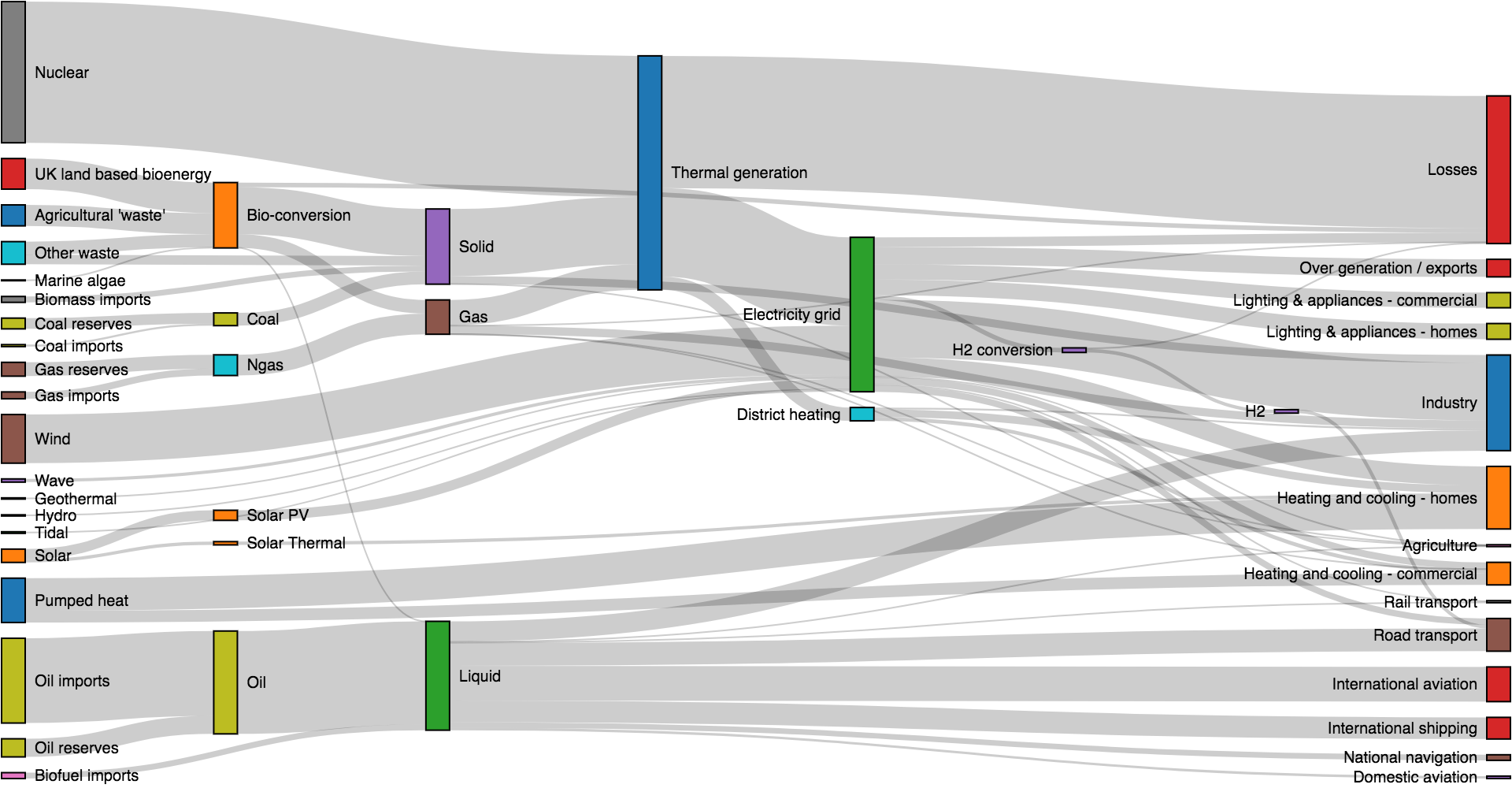
+Sankey diagrams visualize the directed flow between nodes in an acyclic network. For example, this diagram shows a possible scenario of UK energy production and consumption in 2050:
+
+[ ](https://observablehq.com/@d3/sankey-diagram)
+
+Source: Department of Energy & Climate Change, Tom Counsell.
+
+**For an interactive editor, see [Flow-o-Matic](https://observablehq.com/@mbostock/flow-o-matic).**
+
+## Installing
+
+If you use NPM, `npm install d3-sankey`. Otherwise, download the [latest release](https://github.com/d3/d3-sankey/releases/latest). You can also load directly from [unpkg.com](https://unpkg.com/d3-sankey/). AMD, CommonJS, and vanilla environments are supported. In vanilla, a `d3` global is exported:
+
+```html
+
+
+
+
+
+
+```
+
+## API Reference
+
+# d3.sankey() [<>](https://github.com/d3/d3-sankey/blob/master/src/sankey.js "Source")
+
+Constructs a new Sankey generator with the default settings.
+
+# sankey(arguments…) [<>](https://github.com/d3/d3-sankey/blob/master/src/sankey.js "Source")
+
+Computes the node and link positions for the given *arguments*, returning a *graph* representing the Sankey layout. The returned *graph* has the following properties:
+
+* *graph*.nodes - the array of [nodes](#sankey_nodes)
+* *graph*.links - the array of [links](#sankey_links)
+
+# sankey.update(graph) [<>](https://github.com/d3/d3-sankey/blob/master/src/sankey.js "Source")
+
+Recomputes the specified *graph*’s links’ positions, updating the following properties of each *link*:
+
+* *link*.y0 - the link’s vertical starting position (at source node)
+* *link*.y1 - the link’s vertical end position (at target node)
+
+This method is intended to be called after computing the initial [Sankey layout](#_sankey), for example when the diagram is repositioned interactively.
+
+# sankey.nodes([nodes]) [<>](https://github.com/d3/d3-sankey/blob/master/src/sankey.js "Source")
+
+If *nodes* is specified, sets the Sankey generator’s nodes accessor to the specified function or array and returns this Sankey generator. If *nodes* is not specified, returns the current nodes accessor, which defaults to:
+
+```js
+function nodes(graph) {
+ return graph.nodes;
+}
+```
+
+If *nodes* is specified as a function, the function is invoked when the Sankey layout is [generated](#_sankey), being passed any arguments passed to the Sankey generator. This function must return an array of nodes. If *nodes* is not a function, it must be a constant array of *nodes*.
+
+Each *node* must be an object. The following properties are assigned by the [Sankey generator](#_sankey):
+
+* *node*.sourceLinks - the array of outgoing [links](#sankey_links) which have this node as their source
+* *node*.targetLinks - the array of incoming [links](#sankey_links) which have this node as their target
+* *node*.value - the node’s value; this is the sum of *link*.value for the node’s incoming [links](#sankey_links), or *node*.fixedValue if defined
+* *node*.index - the node’s zero-based index within the array of nodes
+* *node*.depth - the node’s zero-based graph depth, derived from the graph topology
+* *node*.height - the node’s zero-based graph height, derived from the graph topology
+* *node*.layer - the node’s zero-based column index, corresponding to its horizontal position
+* *node*.x0 - the node’s minimum horizontal position, derived from *node*.depth
+* *node*.x1 - the node’s maximum horizontal position (*node*.x0 + [*sankey*.nodeWidth](#sankey_nodeWidth))
+* *node*.y0 - the node’s minimum vertical position
+* *node*.y1 - the node’s maximum vertical position (*node*.y1 - *node*.y0 is proportional to *node*.value)
+
+See also [*sankey*.links](#sankey_links).
+
+# sankey.links([links]) [<>](https://github.com/d3/d3-sankey/blob/master/src/sankey.js "Source")
+
+If *links* is specified, sets the Sankey generator’s links accessor to the specified function or array and returns this Sankey generator. If *links* is not specified, returns the current links accessor, which defaults to:
+
+```js
+function links(graph) {
+ return graph.links;
+}
+```
+
+If *links* is specified as a function, the function is invoked when the Sankey layout is [generated](#_sankey), being passed any arguments passed to the Sankey generator. This function must return an array of links. If *links* is not a function, it must be a constant array of *links*.
+
+Each *link* must be an object with the following properties:
+
+* *link*.source - the link’s source [node](#sankey_nodes)
+* *link*.target - the link’s target [node](#sankey_nodes)
+* *link*.value - the link’s numeric value
+
+For convenience, a link’s source and target may be initialized using numeric or string identifiers rather than object references; see [*sankey*.nodeId](#sankey_nodeId). The following properties are assigned to each link by the [Sankey generator](#_sankey):
+
+* *link*.y0 - the link’s vertical starting position (at source node)
+* *link*.y1 - the link’s vertical end position (at target node)
+* *link*.width - the link’s width (proportional to *link*.value)
+* *link*.index - the zero-based index of *link* within the array of links
+
+# sankey.linkSort([sort]) [<>](https://github.com/d3/d3-sankey/blob/master/src/sankey.js "Source")
+
+If *sort* is specified, sets the link sort method and returns this Sankey generator. If *sort* is not specified, returns the current link sort method, which defaults to *undefined*, indicating that vertical order of links within each node will be determined automatically by the layout. If *sort* is null, the order is fixed by the input. Otherwise, the specified *sort* function determines the order; the function is passed two links, and must return a value less than 0 if the first link should be above the second, and a value greater than 0 if the second link should be above the first, or 0 if the order is not specified.
+
+# sankey.nodeId([id]) [<>](https://github.com/d3/d3-sankey/blob/master/src/sankey.js "Source")
+
+If *id* is specified, sets the node id accessor to the specified function and returns this Sankey generator. If *id* is not specified, returns the current node id accessor, which defaults to the numeric *node*.index:
+
+```js
+function id(d) {
+ return d.index;
+}
+```
+
+The default id accessor allows each link’s source and target to be specified as a zero-based index into the [nodes](#sankey_nodes) array. For example:
+
+```js
+var nodes = [
+ {"id": "Alice"},
+ {"id": "Bob"},
+ {"id": "Carol"}
+];
+
+var links = [
+ {"source": 0, "target": 1}, // Alice → Bob
+ {"source": 1, "target": 2} // Bob → Carol
+];
+```
+
+Now consider a different id accessor that returns a string:
+
+```js
+function id(d) {
+ return d.id;
+}
+```
+
+With this accessor, you can use named sources and targets:
+
+```js
+var nodes = [
+ {"id": "Alice"},
+ {"id": "Bob"},
+ {"id": "Carol"}
+];
+
+var links = [
+ {"source": "Alice", "target": "Bob"},
+ {"source": "Bob", "target": "Carol"}
+];
+```
+
+This is particularly useful when representing graphs in JSON, as JSON does not allow references. See [this example](https://bl.ocks.org/mbostock/f584aa36df54c451c94a9d0798caed35).
+
+# sankey.nodeAlign([align]) [<>](https://github.com/d3/d3-sankey/blob/master/src/sankey.js "Source")
+
+If *align* is specified, sets the node [alignment method](#alignments) to the specified function and returns this Sankey generator. If *align* is not specified, returns the current node alignment method, which defaults to [d3.sankeyJustify](#sankeyJustify). The specified function is evaluated for each input *node* in order, being passed the current *node* and the total depth *n* of the graph (one plus the maximum *node*.depth), and must return an integer between 0 and *n* - 1 that indicates the desired horizontal position of the node in the generated Sankey diagram.
+
+# sankey.nodeSort([sort]) [<>](https://github.com/d3/d3-sankey/blob/master/src/sankey.js "Source")
+
+If *sort* is specified, sets the node sort method and returns this Sankey generator. If *sort* is not specified, returns the current node sort method, which defaults to *undefined*, indicating that vertical order of nodes within each column will be determined automatically by the layout. If *sort* is null, the order is fixed by the input. Otherwise, the specified *sort* function determines the order; the function is passed two nodes, and must return a value less than 0 if the first node should be above the second, and a value greater than 0 if the second node should be above the first, or 0 if the order is not specified.
+
+# sankey.nodeWidth([width]) [<>](https://github.com/d3/d3-sankey/blob/master/src/sankey.js "Source")
+
+If *width* is specified, sets the node width to the specified number and returns this Sankey generator. If *width* is not specified, returns the current node width, which defaults to 24.
+
+# sankey.nodePadding([padding]) [<>](https://github.com/d3/d3-sankey/blob/master/src/sankey.js "Source")
+
+If *padding* is specified, sets the vertical separation between nodes at each column to the specified number and returns this Sankey generator. If *padding* is not specified, returns the current node padding, which defaults to 8.
+
+# sankey.extent([extent]) [<>](https://github.com/d3/d3-sankey/blob/master/src/sankey.js "Source")
+
+If *extent* is specified, sets the extent of the Sankey layout to the specified bounds and returns the layout. The *extent* bounds are specified as an array \[\[x0, y0\], \[x1, y1\]\], where *x0* is the left side of the extent, *y0* is the top, *x1* is the right and *y1* is the bottom. If *extent* is not specified, returns the current extent which defaults to [[0, 0], [1, 1]].
+
+# sankey.size([size]) [<>](https://github.com/d3/d3-sankey/blob/master/src/sankey.js "Source")
+
+An alias for [*sankey*.extent](#sankey_extent) where the minimum *x* and *y* of the extent are ⟨0,0⟩. Equivalent to:
+
+```js
+sankey.extent([[0, 0], size]);
+```
+
+# sankey.iterations([iterations]) [<>](https://github.com/d3/d3-sankey/blob/master/src/sankey.js "Source")
+
+If *iterations* is specified, sets the number of relaxation iterations when [generating the layout](#_sankey) and returns this Sankey generator. If *iterations* is not specified, returns the current number of relaxation iterations, which defaults to 6.
+
+### Alignments
+
+See [*sankey*.nodeAlign](#sankey_nodeAlign).
+
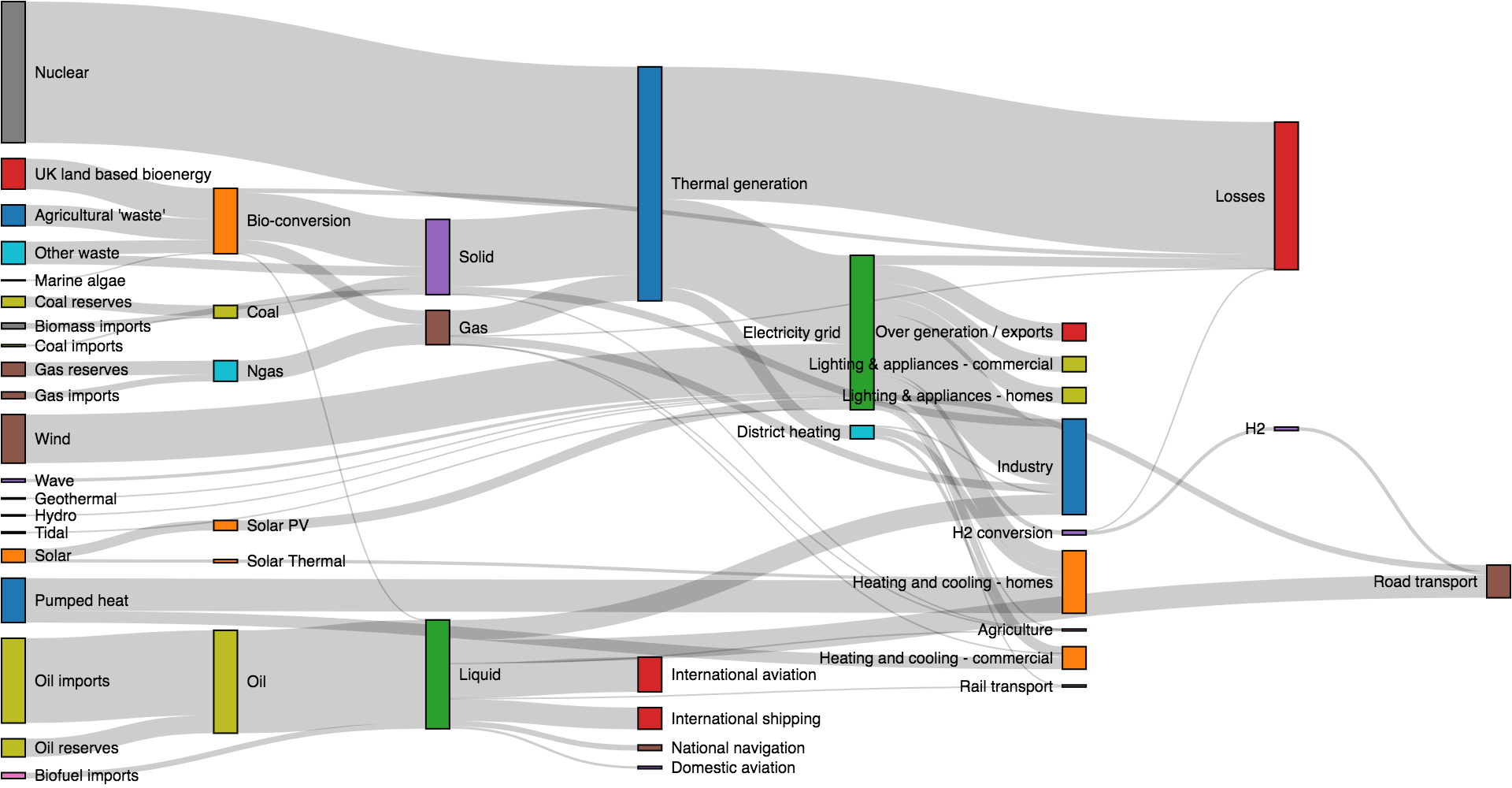
+# d3.sankeyLeft(node, n) [<>](https://github.com/d3/d3-sankey/blob/master/src/align.js "Source")
+
+[
](https://observablehq.com/@d3/sankey-diagram)
+
+Source: Department of Energy & Climate Change, Tom Counsell.
+
+**For an interactive editor, see [Flow-o-Matic](https://observablehq.com/@mbostock/flow-o-matic).**
+
+## Installing
+
+If you use NPM, `npm install d3-sankey`. Otherwise, download the [latest release](https://github.com/d3/d3-sankey/releases/latest). You can also load directly from [unpkg.com](https://unpkg.com/d3-sankey/). AMD, CommonJS, and vanilla environments are supported. In vanilla, a `d3` global is exported:
+
+```html
+
+
+
+
+
+
+```
+
+## API Reference
+
+# d3.sankey() [<>](https://github.com/d3/d3-sankey/blob/master/src/sankey.js "Source")
+
+Constructs a new Sankey generator with the default settings.
+
+# sankey(arguments…) [<>](https://github.com/d3/d3-sankey/blob/master/src/sankey.js "Source")
+
+Computes the node and link positions for the given *arguments*, returning a *graph* representing the Sankey layout. The returned *graph* has the following properties:
+
+* *graph*.nodes - the array of [nodes](#sankey_nodes)
+* *graph*.links - the array of [links](#sankey_links)
+
+# sankey.update(graph) [<>](https://github.com/d3/d3-sankey/blob/master/src/sankey.js "Source")
+
+Recomputes the specified *graph*’s links’ positions, updating the following properties of each *link*:
+
+* *link*.y0 - the link’s vertical starting position (at source node)
+* *link*.y1 - the link’s vertical end position (at target node)
+
+This method is intended to be called after computing the initial [Sankey layout](#_sankey), for example when the diagram is repositioned interactively.
+
+# sankey.nodes([nodes]) [<>](https://github.com/d3/d3-sankey/blob/master/src/sankey.js "Source")
+
+If *nodes* is specified, sets the Sankey generator’s nodes accessor to the specified function or array and returns this Sankey generator. If *nodes* is not specified, returns the current nodes accessor, which defaults to:
+
+```js
+function nodes(graph) {
+ return graph.nodes;
+}
+```
+
+If *nodes* is specified as a function, the function is invoked when the Sankey layout is [generated](#_sankey), being passed any arguments passed to the Sankey generator. This function must return an array of nodes. If *nodes* is not a function, it must be a constant array of *nodes*.
+
+Each *node* must be an object. The following properties are assigned by the [Sankey generator](#_sankey):
+
+* *node*.sourceLinks - the array of outgoing [links](#sankey_links) which have this node as their source
+* *node*.targetLinks - the array of incoming [links](#sankey_links) which have this node as their target
+* *node*.value - the node’s value; this is the sum of *link*.value for the node’s incoming [links](#sankey_links), or *node*.fixedValue if defined
+* *node*.index - the node’s zero-based index within the array of nodes
+* *node*.depth - the node’s zero-based graph depth, derived from the graph topology
+* *node*.height - the node’s zero-based graph height, derived from the graph topology
+* *node*.layer - the node’s zero-based column index, corresponding to its horizontal position
+* *node*.x0 - the node’s minimum horizontal position, derived from *node*.depth
+* *node*.x1 - the node’s maximum horizontal position (*node*.x0 + [*sankey*.nodeWidth](#sankey_nodeWidth))
+* *node*.y0 - the node’s minimum vertical position
+* *node*.y1 - the node’s maximum vertical position (*node*.y1 - *node*.y0 is proportional to *node*.value)
+
+See also [*sankey*.links](#sankey_links).
+
+# sankey.links([links]) [<>](https://github.com/d3/d3-sankey/blob/master/src/sankey.js "Source")
+
+If *links* is specified, sets the Sankey generator’s links accessor to the specified function or array and returns this Sankey generator. If *links* is not specified, returns the current links accessor, which defaults to:
+
+```js
+function links(graph) {
+ return graph.links;
+}
+```
+
+If *links* is specified as a function, the function is invoked when the Sankey layout is [generated](#_sankey), being passed any arguments passed to the Sankey generator. This function must return an array of links. If *links* is not a function, it must be a constant array of *links*.
+
+Each *link* must be an object with the following properties:
+
+* *link*.source - the link’s source [node](#sankey_nodes)
+* *link*.target - the link’s target [node](#sankey_nodes)
+* *link*.value - the link’s numeric value
+
+For convenience, a link’s source and target may be initialized using numeric or string identifiers rather than object references; see [*sankey*.nodeId](#sankey_nodeId). The following properties are assigned to each link by the [Sankey generator](#_sankey):
+
+* *link*.y0 - the link’s vertical starting position (at source node)
+* *link*.y1 - the link’s vertical end position (at target node)
+* *link*.width - the link’s width (proportional to *link*.value)
+* *link*.index - the zero-based index of *link* within the array of links
+
+# sankey.linkSort([sort]) [<>](https://github.com/d3/d3-sankey/blob/master/src/sankey.js "Source")
+
+If *sort* is specified, sets the link sort method and returns this Sankey generator. If *sort* is not specified, returns the current link sort method, which defaults to *undefined*, indicating that vertical order of links within each node will be determined automatically by the layout. If *sort* is null, the order is fixed by the input. Otherwise, the specified *sort* function determines the order; the function is passed two links, and must return a value less than 0 if the first link should be above the second, and a value greater than 0 if the second link should be above the first, or 0 if the order is not specified.
+
+# sankey.nodeId([id]) [<>](https://github.com/d3/d3-sankey/blob/master/src/sankey.js "Source")
+
+If *id* is specified, sets the node id accessor to the specified function and returns this Sankey generator. If *id* is not specified, returns the current node id accessor, which defaults to the numeric *node*.index:
+
+```js
+function id(d) {
+ return d.index;
+}
+```
+
+The default id accessor allows each link’s source and target to be specified as a zero-based index into the [nodes](#sankey_nodes) array. For example:
+
+```js
+var nodes = [
+ {"id": "Alice"},
+ {"id": "Bob"},
+ {"id": "Carol"}
+];
+
+var links = [
+ {"source": 0, "target": 1}, // Alice → Bob
+ {"source": 1, "target": 2} // Bob → Carol
+];
+```
+
+Now consider a different id accessor that returns a string:
+
+```js
+function id(d) {
+ return d.id;
+}
+```
+
+With this accessor, you can use named sources and targets:
+
+```js
+var nodes = [
+ {"id": "Alice"},
+ {"id": "Bob"},
+ {"id": "Carol"}
+];
+
+var links = [
+ {"source": "Alice", "target": "Bob"},
+ {"source": "Bob", "target": "Carol"}
+];
+```
+
+This is particularly useful when representing graphs in JSON, as JSON does not allow references. See [this example](https://bl.ocks.org/mbostock/f584aa36df54c451c94a9d0798caed35).
+
+# sankey.nodeAlign([align]) [<>](https://github.com/d3/d3-sankey/blob/master/src/sankey.js "Source")
+
+If *align* is specified, sets the node [alignment method](#alignments) to the specified function and returns this Sankey generator. If *align* is not specified, returns the current node alignment method, which defaults to [d3.sankeyJustify](#sankeyJustify). The specified function is evaluated for each input *node* in order, being passed the current *node* and the total depth *n* of the graph (one plus the maximum *node*.depth), and must return an integer between 0 and *n* - 1 that indicates the desired horizontal position of the node in the generated Sankey diagram.
+
+# sankey.nodeSort([sort]) [<>](https://github.com/d3/d3-sankey/blob/master/src/sankey.js "Source")
+
+If *sort* is specified, sets the node sort method and returns this Sankey generator. If *sort* is not specified, returns the current node sort method, which defaults to *undefined*, indicating that vertical order of nodes within each column will be determined automatically by the layout. If *sort* is null, the order is fixed by the input. Otherwise, the specified *sort* function determines the order; the function is passed two nodes, and must return a value less than 0 if the first node should be above the second, and a value greater than 0 if the second node should be above the first, or 0 if the order is not specified.
+
+# sankey.nodeWidth([width]) [<>](https://github.com/d3/d3-sankey/blob/master/src/sankey.js "Source")
+
+If *width* is specified, sets the node width to the specified number and returns this Sankey generator. If *width* is not specified, returns the current node width, which defaults to 24.
+
+# sankey.nodePadding([padding]) [<>](https://github.com/d3/d3-sankey/blob/master/src/sankey.js "Source")
+
+If *padding* is specified, sets the vertical separation between nodes at each column to the specified number and returns this Sankey generator. If *padding* is not specified, returns the current node padding, which defaults to 8.
+
+# sankey.extent([extent]) [<>](https://github.com/d3/d3-sankey/blob/master/src/sankey.js "Source")
+
+If *extent* is specified, sets the extent of the Sankey layout to the specified bounds and returns the layout. The *extent* bounds are specified as an array \[\[x0, y0\], \[x1, y1\]\], where *x0* is the left side of the extent, *y0* is the top, *x1* is the right and *y1* is the bottom. If *extent* is not specified, returns the current extent which defaults to [[0, 0], [1, 1]].
+
+# sankey.size([size]) [<>](https://github.com/d3/d3-sankey/blob/master/src/sankey.js "Source")
+
+An alias for [*sankey*.extent](#sankey_extent) where the minimum *x* and *y* of the extent are ⟨0,0⟩. Equivalent to:
+
+```js
+sankey.extent([[0, 0], size]);
+```
+
+# sankey.iterations([iterations]) [<>](https://github.com/d3/d3-sankey/blob/master/src/sankey.js "Source")
+
+If *iterations* is specified, sets the number of relaxation iterations when [generating the layout](#_sankey) and returns this Sankey generator. If *iterations* is not specified, returns the current number of relaxation iterations, which defaults to 6.
+
+### Alignments
+
+See [*sankey*.nodeAlign](#sankey_nodeAlign).
+
+# d3.sankeyLeft(node, n) [<>](https://github.com/d3/d3-sankey/blob/master/src/align.js "Source")
+
+[ ](https://observablehq.com/@d3/sankey-diagram?align=left)
+
+Returns *node*.depth.
+
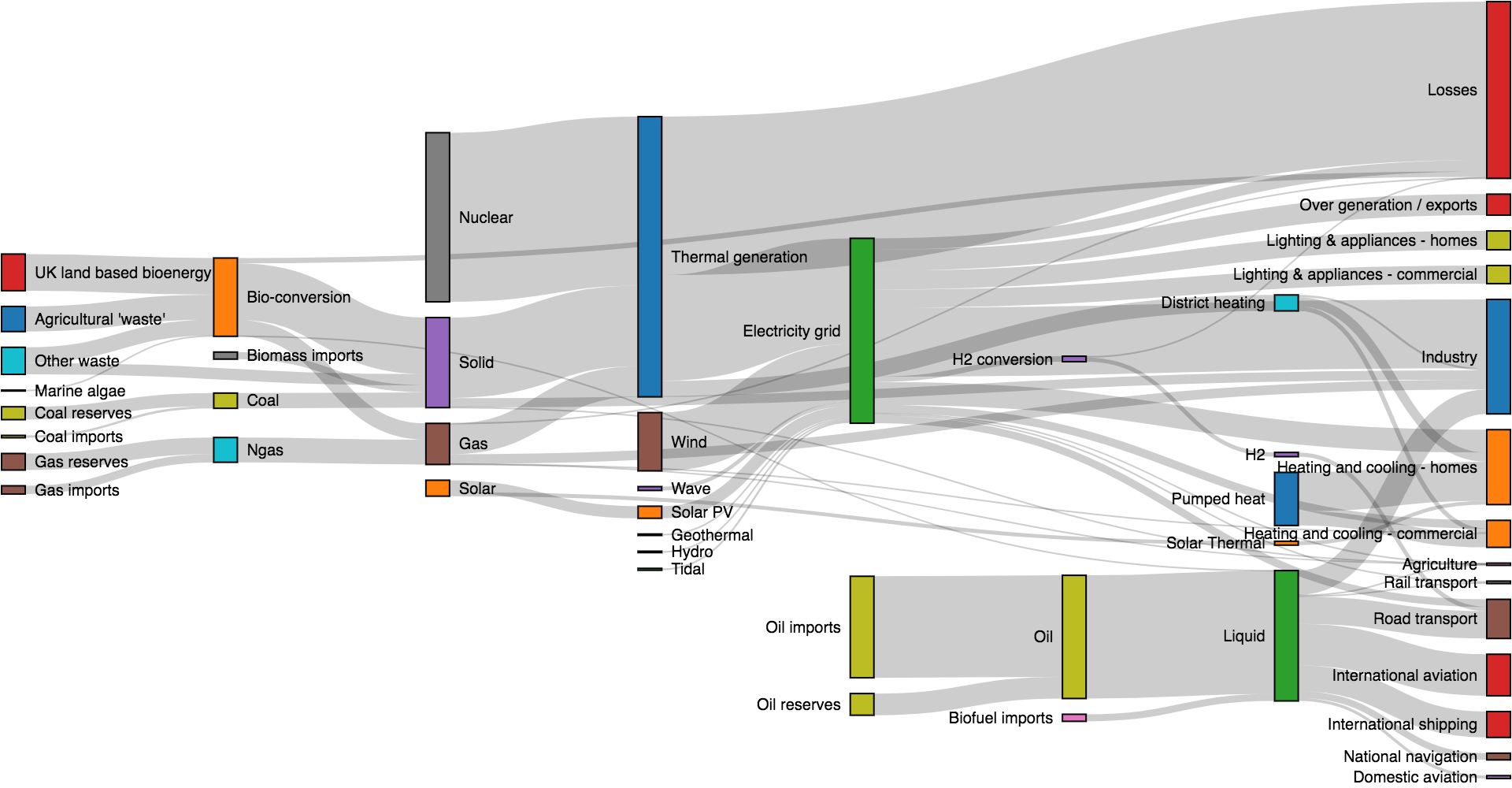
+# d3.sankeyRight(node, n) [<>](https://github.com/d3/d3-sankey/blob/master/src/align.js "Source")
+
+[
](https://observablehq.com/@d3/sankey-diagram?align=left)
+
+Returns *node*.depth.
+
+# d3.sankeyRight(node, n) [<>](https://github.com/d3/d3-sankey/blob/master/src/align.js "Source")
+
+[ ](https://observablehq.com/@d3/sankey-diagram?align=right)
+
+Returns *n* - 1 - *node*.height.
+
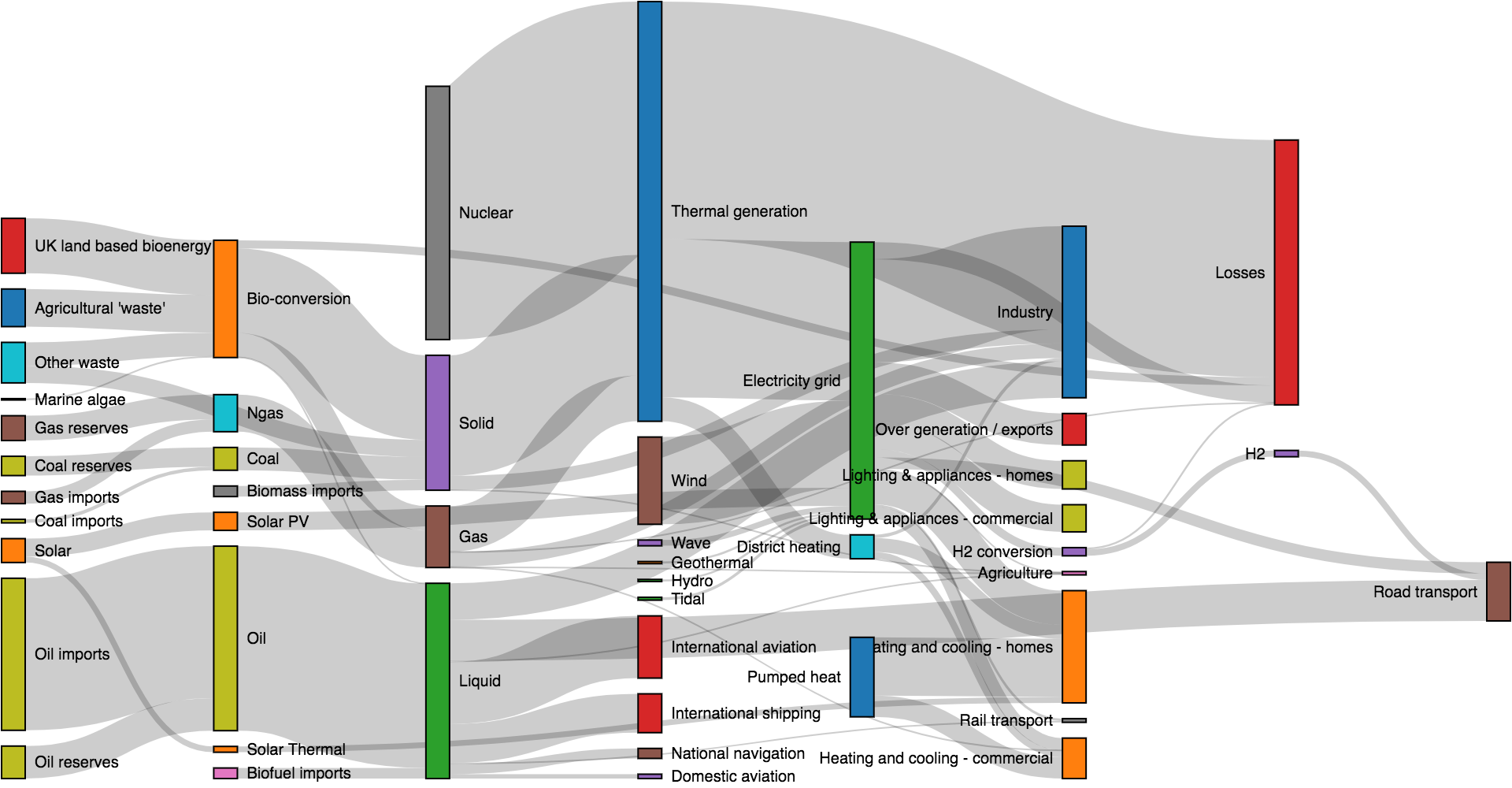
+# d3.sankeyCenter(node, n) [<>](https://github.com/d3/d3-sankey/blob/master/src/align.js "Source")
+
+[
](https://observablehq.com/@d3/sankey-diagram?align=right)
+
+Returns *n* - 1 - *node*.height.
+
+# d3.sankeyCenter(node, n) [<>](https://github.com/d3/d3-sankey/blob/master/src/align.js "Source")
+
+[ ](https://observablehq.com/@d3/sankey-diagram?align=center)
+
+Like [d3.sankeyLeft](#sankeyLeft), except that nodes without any incoming links are moved as right as possible.
+
+# d3.sankeyJustify(node, n) [<>](https://github.com/d3/d3-sankey/blob/master/src/align.js "Source")
+
+[](https://observablehq.com/@d3/sankey-diagram)
+
+Like [d3.sankeyLeft](#sankeyLeft), except that nodes without any outgoing links are moved to the far right.
+
+### Links
+
+# d3.sankeyLinkHorizontal() [<>](https://github.com/d3/d3-sankey/blob/master/src/sankeyLinkHorizontal.js "Source")
+
+Returns a [horizontal link shape](https://github.com/d3/d3-shape/blob/master/README.md#linkHorizontal) suitable for a Sankey diagram. The [source accessor](https://github.com/d3/d3-shape/blob/master/README.md#link_source) is defined as:
+
+```js
+function source(d) {
+ return [d.source.x1, d.y0];
+}
+```
+
+The [target accessor](https://github.com/d3/d3-shape/blob/master/README.md#link_target) is defined as:
+
+```js
+function target(d) {
+ return [d.target.x0, d.y1];
+}
+```
+
+For example, to render the links of a Sankey diagram in SVG, you might say:
+
+```js
+svg.append("g")
+ .attr("fill", "none")
+ .attr("stroke", "#000")
+ .attr("stroke-opacity", 0.2)
+ .selectAll("path")
+ .data(graph.links)
+ .join("path")
+ .attr("d", d3.sankeyLinkHorizontal())
+ .attr("stroke-width", function(d) { return d.width; });
+```
](https://observablehq.com/@d3/sankey-diagram?align=center)
+
+Like [d3.sankeyLeft](#sankeyLeft), except that nodes without any incoming links are moved as right as possible.
+
+# d3.sankeyJustify(node, n) [<>](https://github.com/d3/d3-sankey/blob/master/src/align.js "Source")
+
+[](https://observablehq.com/@d3/sankey-diagram)
+
+Like [d3.sankeyLeft](#sankeyLeft), except that nodes without any outgoing links are moved to the far right.
+
+### Links
+
+# d3.sankeyLinkHorizontal() [<>](https://github.com/d3/d3-sankey/blob/master/src/sankeyLinkHorizontal.js "Source")
+
+Returns a [horizontal link shape](https://github.com/d3/d3-shape/blob/master/README.md#linkHorizontal) suitable for a Sankey diagram. The [source accessor](https://github.com/d3/d3-shape/blob/master/README.md#link_source) is defined as:
+
+```js
+function source(d) {
+ return [d.source.x1, d.y0];
+}
+```
+
+The [target accessor](https://github.com/d3/d3-shape/blob/master/README.md#link_target) is defined as:
+
+```js
+function target(d) {
+ return [d.target.x0, d.y1];
+}
+```
+
+For example, to render the links of a Sankey diagram in SVG, you might say:
+
+```js
+svg.append("g")
+ .attr("fill", "none")
+ .attr("stroke", "#000")
+ .attr("stroke-opacity", 0.2)
+ .selectAll("path")
+ .data(graph.links)
+ .join("path")
+ .attr("d", d3.sankeyLinkHorizontal())
+ .attr("stroke-width", function(d) { return d.width; });
+```