| Version 2 (modified by , 7 months ago) ( diff ) |
|---|
Entity-Relationship Model v01
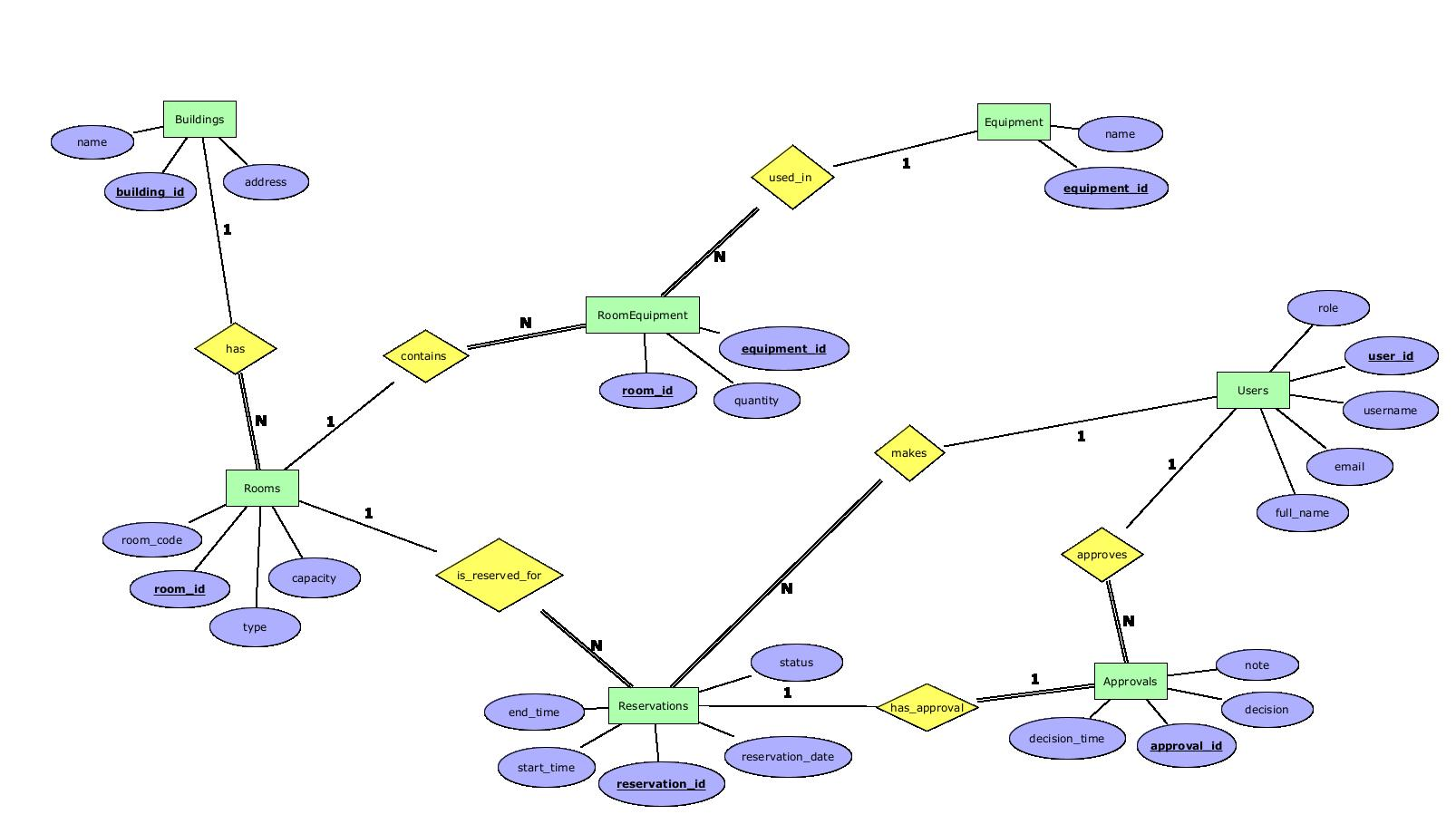
Diagram

(Attached files: ERModel_v01.xml and ERModel_v01.jpg)
Data requirements
Entities
Buildings
*Description: Represents a physical building that contains multiple rooms that can be reserved. *Candidate keys:
- building_id (selected as primary key because it is stable and unique)
- (optional candidate) (name, address) if the institution guarantees uniqueness, but it is not reliable -> not selected
*Attributes:
- building_id (NUMBER(9,2) / or NUMBER) – required, unique identifier (PK)
- name (VARCHAR2(128)) – required
- address (VARCHAR2(128)) – required
Rooms
*Description: Represents a reservable room (classroom/office/meeting room) located in a building. *Candidate keys:
- room_id (selected as primary key because it is stable and unique)
- room_code (candidate key if it is unique across the organization)
*Attributes:
- room_id (VARCHAR2(128) / or NUMBER) – required, unique identifier (PK)
- room_code (VARCHAR2(128)) – required; should be unique (recommended UNIQUE constraint)
- capacity (NUMBER or NUMBER(9,2)) – required; value interval: capacity > 0
- type (VARCHAR2(128)) – required; suggested domain: {classroom, office, meeting_room, lab, ...}
Equipment
*Description: Represents an item of equipment that may exist in rooms (e.g., projector, whiteboard, microphone). *Candidate keys:
- equipment_id (selected as primary key)
- name (candidate only if guaranteed unique, usually not guaranteed)
*Attributes:
- equipment_id (VARCHAR2(128) / or NUMBER) – required, unique identifier (PK)
- name (VARCHAR2(128)) – required
RoomEquipment
*Description: Associative entity that models the many-to-many relationship between Rooms and Equipment. It stores how many units of a specific equipment exist in a room. *Candidate keys:
- (room_id, equipment_id) (selected as primary key, natural composite key)
*Attributes:
- room_id (FK reference to Rooms) – required
- equipment_id (FK reference to Equipment) – required
- quantity (NUMBER) – required; value interval: quantity >= 0 (usually > 0 if present)
Users
*Description: Represents system users who can create reservations and (if authorized) approve them. *Candidate keys:
- user_id (selected as primary key)
- username (candidate key, should be unique)
- email (candidate key, should be unique)
*Attributes:
- user_id (VARCHAR2(128) / or NUMBER) – required, unique identifier (PK)
- username (VARCHAR2(128)) – required; should be unique
- email (VARCHAR2(128)) – required; should be unique; format constraint (contains '@')
- full_name (VARCHAR2(128)) – required
- role (VARCHAR2(128)) – required; suggested domain: {regular, admin/approver}
Reservations
*Description: Represents a reservation request made by a user for a specific room, date and time interval. The system must prevent overlapping reservations for the same room and time. *Candidate keys:
- reservation_id (selected as primary key)
- (room_id, reservation_date, start_time, end_time) may form a natural candidate key, but usually we still keep a surrogate PK
*Attributes:
- reservation_id (VARCHAR2(128) / or NUMBER) – required, unique identifier (PK)
- reservation_date (DATE) – required
- start_time (DATE or TIME representation) – required
- end_time (DATE or TIME representation) – required; constraint: end_time > start_time
- status (VARCHAR2(128)) – required; suggested domain: {pending, approved, rejected, cancelled}
Approvals
*Description: Represents an approval decision for a reservation, created by an authorized user (approver/admin). Each approval stores decision, decision time and an optional note. *Candidate keys:
- approval_id (selected as primary key)
- reservation_id could be unique because one reservation has at most one approval (depending on business rule)
*Attributes:
- approval_id (VARCHAR2(128) / or NUMBER) – required, unique identifier (PK)
- decision (VARCHAR2(128)) – required; suggested domain: {approved, rejected}
- decision_time (DATE) – required
- note (VARCHAR2(128)) – optional
Relationships
has (Buildings–Rooms)
*Meaning: A building contains rooms. *Cardinality: Buildings (1) — Rooms (N) *Participation:
- Room participation is total (each room must belong to exactly one building).
- Building participation is partial (a building may have zero or more rooms).
contains (Rooms–RoomEquipment)
*Meaning: A room contains equipment entries (with quantities). *Cardinality: Rooms (1) — RoomEquipment (N) *Participation:
- RoomEquipment participation is total (each RoomEquipment must belong to exactly one room).
- Room participation is partial (a room may have no equipment registered).
used_in (Equipment–RoomEquipment)
*Meaning: Equipment item appears in room-equipment entries. *Cardinality: Equipment (1) — RoomEquipment (N) *Participation:
- RoomEquipment participation is total (each entry refers to exactly one equipment item).
- Equipment participation is partial (an equipment type may be defined even if not currently used in any room).
is_reserved_for (Rooms–Reservations)
*Meaning: Each reservation is for exactly one room. *Cardinality: Rooms (1) — Reservations (N) *Participation:
- Reservation participation is total (each reservation must specify a room).
- Room participation is partial (a room may have no reservations).
makes (Users–Reservations)
*Meaning: Users create reservations. *Cardinality: Users (1) — Reservations (N) *Participation:
- Reservation participation is total (each reservation must be created by one user).
- User participation is partial (a user may have zero reservations).
has_approval (Reservations–Approvals)
*Meaning: A reservation may have an approval decision. *Cardinality: Reservations (1) — Approvals (1) with optional on reservation side *Participation:
- Approval participation is total (approval cannot exist without reservation).
- Reservation participation is partial (reservation may still be pending with no approval record).
approves (Users–Approvals)
*Meaning: Authorized users approve or reject reservations. *Cardinality: Users (1) — Approvals (N) *Participation:
- Approval participation is total (each approval is made by exactly one user).
- User participation is partial (not every user must approve reservations).
Entity-Relationship Model History
- v01 – Initial version of the ER model. Includes: Buildings, Rooms, Equipment, RoomEquipment (associative entity), Users, Reservations and Approvals, along with all required relationships and cardinalities.
Attachments (6)
- ERModel_v01.xml (27.3 KB ) - added by 7 months ago.
- ERModel_v01.png (437.0 KB ) - added by 3 months ago.
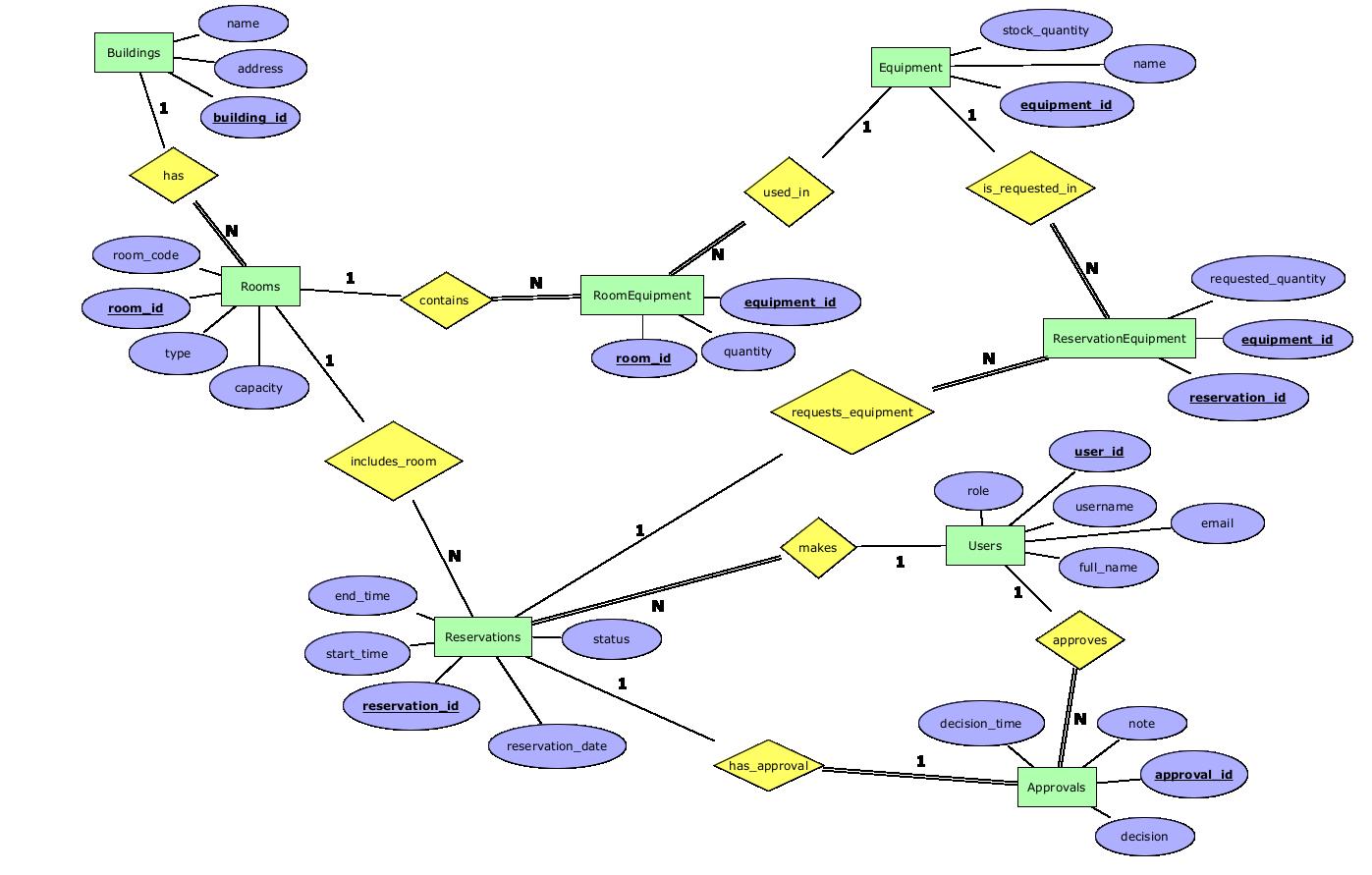
- ERModel_v02.xml (32.6 KB ) - added by 3 months ago.
- ERModel_v02.png (119.8 KB ) - added by 3 months ago.
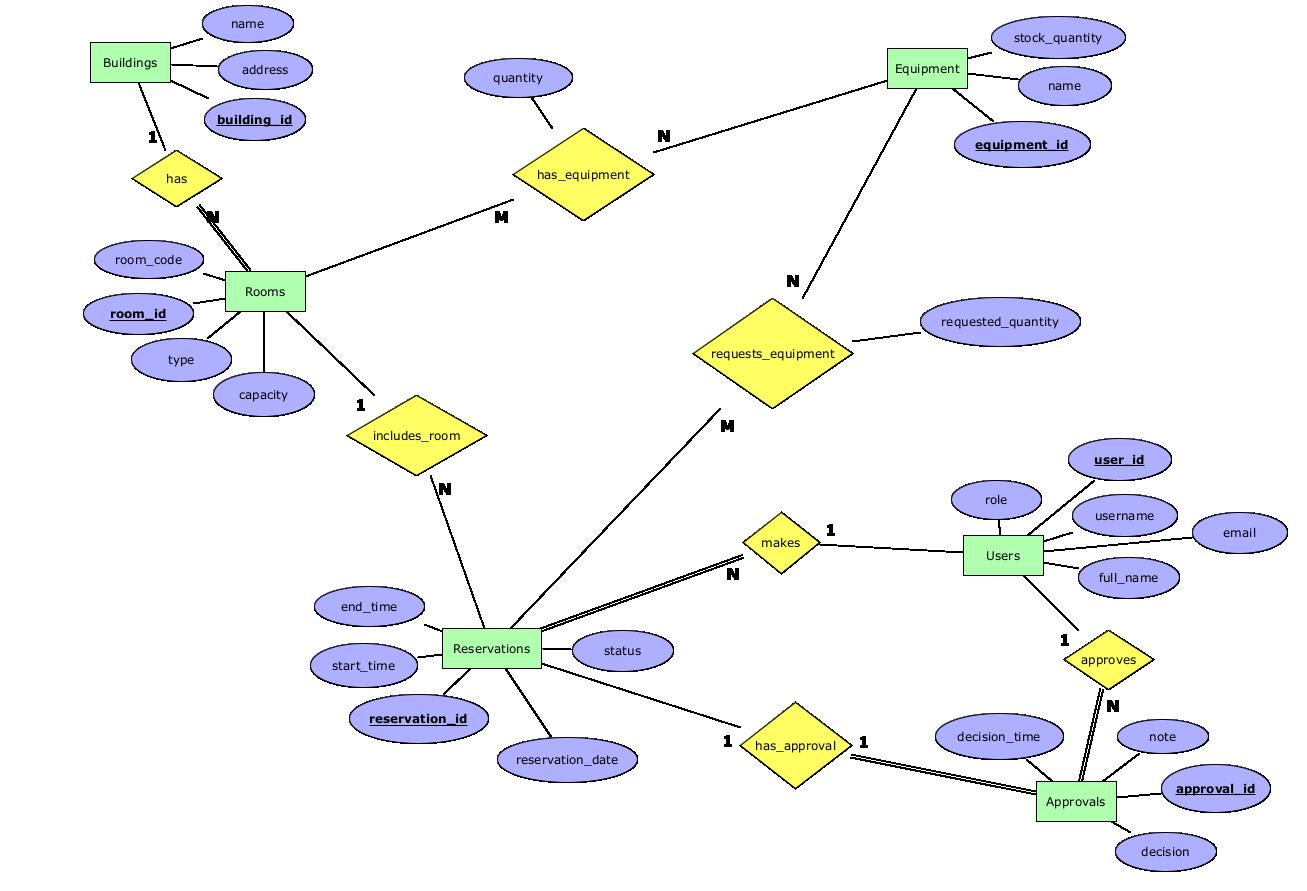
- ERModel_v03.xml (26.8 KB ) - added by 2 months ago.
- ERModel_v03.png (103.9 KB ) - added by 2 months ago.
Download all attachments as: .zip