Relational Design
Descriptive representation of the relational schema
Notation: bold = primary key, italic = foreign key.
- Users(id, username, email, full_name, password_hash, available_balance, invested_balance, created_at, updated_at)
- Candidate keys:
{id},{username},{email}.UNIQUE(username),UNIQUE(email).
- Candidate keys:
- Crypto(id, symbol, name, created_at)
- Candidate keys:
{id},{symbol}.UNIQUE(symbol).
- Candidate keys:
- Markets(id, crypto_id, quote_currency, is_active, created_at)
- Candidate keys:
{id},{crypto_id, quote_currency}.UNIQUE(crypto_id, quote_currency).
- Candidate keys:
- Holdings(id, user_id, crypto_id, quantity, reserved_quantity, avg_price, created_at, updated_at)
- Transformation of the M:N relationship
Holds. Candidate keys:{id}and{user_id, crypto_id}— the latter is the relationship's own key and is enforced withUNIQUE(user_id, crypto_id).idwas chosen as PK for consistency with the other relations. avg_priceisNOT NULL DEFAULT 0 CHECK (avg_price >= 0).reserved_quantityisNOT NULL DEFAULT 0 CHECK (reserved_quantity >= 0 AND reserved_quantity <= quantity)— the amount already committed to the user's own open sell orders.quantity - reserved_quantity(the amount actually free to sell) is not a stored column; it is computed wherever needed, inv_portfolioasavailable_quantityand in the sell path of UseCase0005. See theHoldssection of ERModel for why this mirrorsavailable_balance/invested_balanceonUsers.
- Transformation of the M:N relationship
- Orders(id, user_id, market_id, side, type, status, quantity, price, placed_at, executed_at)
side ∈ {buy, sell},type ∈ {market, limit},status ∈ {open, executed, cancelled}.
- Transactions(id, user_id, type, amount, currency, related_order, created_at, description)
type ∈ {deposit, buy, sell, fee}.
- MarketTrades(id, market_id, executed_at, price, quantity, side, source)
- MarketCandles(id, market_id, timeframe, open, high, low, close, volume, candle_time)
UNIQUE(market_id, timeframe, candle_time).
- Watchlists(id, user_id, name, created_at)
- WatchlistItems(id, watchlist_id, crypto_id, added_at)
- Transformation of the M:N relationship
Contains. Candidate keys:{id}and{watchlist_id, crypto_id}, the latter enforced withUNIQUE(watchlist_id, crypto_id).
- Transformation of the M:N relationship
Transformation method used
Partial transformation. Applied as follows:
- Each of the 8 entity sets in ERModel becomes one table, keeping its UUID (or serial) primary key.
- Each 1:N relationship without attributes is transformed by adding the
parent's primary key as a foreign-key column on the child table — the "N"
side. This is where every foreign key in the schema comes from, and it is why
no foreign keys appear in the ER diagram itself:
QuotedOn→markets.crypto_id,PlacedOn→orders.market_id,Places→orders.user_id,Records→transactions.user_id,Settles→transactions.related_order,Fills→market_trades.market_id,Aggregates→market_candles.market_id,Owns→watchlists.user_id. - Each M:N relationship becomes its own table holding the two foreign keys
plus the relationship's own attributes:
Holds→holdings,Contains→watchlist_items. The pair of foreign keys is the relationship's key and is enforced as aUNIQUEconstraint in both tables. - Total participation in the ER model becomes
NOT NULLon the corresponding foreign key; partial participation stays nullable.Settlesis partial on both sides, which is exactly whytransactions.related_orderis the one nullable foreign key in the schema — a deposit has no originating order.
Reservation and the order lifecycle
holdings.reserved_quantity exists so that placing a sell order can be
checked against what a user actually has free to sell
(quantity - reserved_quantity), not against the raw quantity, which also
counts crypto already promised to another order that has not settled yet.
CHECK (reserved_quantity >= 0 AND reserved_quantity <= quantity) makes an
inconsistent reservation impossible at the database level, regardless of what
application code does. The exact statement sequence — lock the row, check the
available amount, reserve, then settle — is in
UseCase0005; the same
SELECT … FOR UPDATE locking that already protected users.available_balance
on the buy path is what makes two concurrent sell orders against the same
holding serialize correctly instead of racing.
DDL script
The script that creates the entire schema is ../server/db/schema_creation.sql (shown in full below). It is idempotent: it drops and recreates the project schema every run, so it works on an empty database and on a database that already has the schema.
The script creates:
- 10 tables with check constraints, primary keys, foreign keys and unique constraints.
- 5 performance indexes.
- 2 views:
v_latest_prices(latest trade price per market) andv_portfolio(per-user holdings valuation with unrealised P/L, plusreserved_quantityand the derivedavailable_quantity).
schema_creation.sql
The two report functions at the end of the file (report_top_traders and report_market_performance) belong to Phase 6 (AdvancedReports) and are left out here.
-- schema_creation.sql
-- EduBerza - crypto exchange simulation database
-- Course: Databases 2025/2026 Winter, FINKI UKIM
--
-- This script is idempotent. It drops the `project` schema and all contained
-- objects, then recreates them from scratch. Safe to run on an empty database
-- or on a database where the schema already exists.

DROP SCHEMA IF EXISTS project CASCADE;
CREATE SCHEMA project;

CREATE EXTENSION IF NOT EXISTS pgcrypto;

SET search_path TO project, public;

-- ============================================================================
-- USERS
-- Platform users. Each user has virtual (prop) balances used for simulation.
-- ============================================================================
CREATE TABLE project.users (
    id                uuid            PRIMARY KEY DEFAULT gen_random_uuid(),
    username          varchar(50)     NOT NULL UNIQUE,
    email             varchar(255)    NOT NULL UNIQUE,
    full_name         varchar(200),
    password_hash     varchar(255)    NOT NULL,
    available_balance numeric(18,4)   NOT NULL DEFAULT 0 CHECK (available_balance >= 0),
    invested_balance  numeric(18,4)   NOT NULL DEFAULT 0 CHECK (invested_balance  >= 0),
    created_at        timestamptz     NOT NULL DEFAULT now(),
    updated_at        timestamptz
);

-- ============================================================================
-- CRYPTO
-- Catalog of crypto assets available on the platform.
-- ============================================================================
CREATE TABLE project.crypto (
    id         uuid         PRIMARY KEY DEFAULT gen_random_uuid(),
    symbol     varchar(20)  NOT NULL UNIQUE,
    name       varchar(255) NOT NULL,
    created_at timestamptz  NOT NULL DEFAULT now()
);

-- ============================================================================
-- MARKETS
-- A market is a (crypto, quote_currency) pair, e.g. BTC/USD.
-- ============================================================================
CREATE TABLE project.markets (
    id             uuid        PRIMARY KEY DEFAULT gen_random_uuid(),
    crypto_id      uuid        NOT NULL REFERENCES project.crypto(id),
    quote_currency char(3)     NOT NULL DEFAULT 'USD',
    is_active      boolean     NOT NULL DEFAULT true,
    created_at     timestamptz NOT NULL DEFAULT now(),
    CONSTRAINT uq_markets UNIQUE (crypto_id, quote_currency)
);

-- ============================================================================
-- HOLDINGS
-- Per-user crypto position with running weighted average entry price.
-- ============================================================================
CREATE TABLE project.holdings (
    id                uuid           PRIMARY KEY DEFAULT gen_random_uuid(),
    user_id           uuid           NOT NULL REFERENCES project.users(id)  ON DELETE CASCADE,
    crypto_id         uuid           NOT NULL REFERENCES project.crypto(id),
    quantity          numeric(20,4)  NOT NULL CHECK (quantity >= 0),
    -- Committed to the user's own open sell orders, not yet removed from the
    -- position. quantity - reserved_quantity is what is actually free to
    -- sell — the crypto-side equivalent of users.available_balance.
    reserved_quantity numeric(20,4)  NOT NULL DEFAULT 0
                                      CHECK (reserved_quantity >= 0 AND reserved_quantity <= quantity),
    -- Weighted-average entry price. NOT NULL so that the P/L arithmetic in
    -- v_portfolio can never silently produce NULL for an existing position.
    avg_price         numeric(18,6)  NOT NULL DEFAULT 0 CHECK (avg_price >= 0),
    created_at        timestamptz    NOT NULL DEFAULT now(),
    updated_at        timestamptz,
    CONSTRAINT uq_holdings_user_crypto UNIQUE (user_id, crypto_id)
);

-- ============================================================================
-- ORDERS
-- Orders placed by users on a market.
-- ============================================================================
CREATE TABLE project.orders (
    id          uuid           PRIMARY KEY DEFAULT gen_random_uuid(),
    user_id     uuid           NOT NULL REFERENCES project.users(id)   ON DELETE CASCADE,
    market_id   uuid           NOT NULL REFERENCES project.markets(id),
    side        varchar(4)     NOT NULL CHECK (side   IN ('buy', 'sell')),
    type        varchar(20)    NOT NULL CHECK (type   IN ('market', 'limit')),
    status      varchar(20)    NOT NULL CHECK (status IN ('open', 'executed', 'cancelled')),
    quantity    numeric(20,4)  NOT NULL CHECK (quantity > 0),
    price       numeric(18,6),
    placed_at   timestamptz    NOT NULL DEFAULT now(),
    executed_at timestamptz
);

CREATE INDEX idx_orders_user      ON project.orders(user_id);
CREATE INDEX idx_orders_market    ON project.orders(market_id);
CREATE INDEX idx_orders_status    ON project.orders(status);

-- ============================================================================
-- TRANSACTIONS
-- Financial ledger: deposits, buys, sells, fees.
-- ============================================================================
CREATE TABLE project.transactions (
    id            uuid           PRIMARY KEY DEFAULT gen_random_uuid(),
    user_id       uuid           NOT NULL REFERENCES project.users(id) ON DELETE CASCADE,
    type          varchar(50)    NOT NULL CHECK (type IN ('deposit', 'buy', 'sell', 'fee')),
    amount        numeric(18,4)  NOT NULL,
    currency      char(3)        NOT NULL DEFAULT 'USD',
    related_order uuid           REFERENCES project.orders(id),
    created_at    timestamptz    NOT NULL DEFAULT now(),
    description   text
);

CREATE INDEX idx_transactions_user ON project.transactions(user_id, created_at DESC);

-- ============================================================================
-- MARKET TRADES
-- Raw executed trades on a market. Source of truth for current price.
-- ============================================================================
CREATE TABLE project.market_trades (
    id          bigserial      PRIMARY KEY,
    market_id   uuid           NOT NULL REFERENCES project.markets(id),
    executed_at timestamptz    NOT NULL,
    price       numeric(18,6)  NOT NULL CHECK (price    > 0),
    quantity    numeric(20,6)  NOT NULL CHECK (quantity > 0),
    side        varchar(4)     CHECK (side IN ('buy', 'sell')),
    source      varchar(50)    NOT NULL DEFAULT 'simulation'
);

CREATE INDEX idx_market_trades_market_time ON project.market_trades(market_id, executed_at DESC);

-- ============================================================================
-- MARKET CANDLES
-- OHLCV aggregates over standard timeframes.
-- ============================================================================
CREATE TABLE project.market_candles (
    id          bigserial      PRIMARY KEY,
    market_id   uuid           NOT NULL REFERENCES project.markets(id),
    timeframe   varchar(5)     NOT NULL CHECK (timeframe IN ('1m', '5m', '1h', '1d')),
    open        numeric(18,6)  NOT NULL,
    high        numeric(18,6)  NOT NULL,
    low         numeric(18,6)  NOT NULL,
    close       numeric(18,6)  NOT NULL,
    volume      numeric(20,6)  NOT NULL,
    candle_time timestamptz    NOT NULL,
    CONSTRAINT uq_candle UNIQUE (market_id, timeframe, candle_time)
);

CREATE INDEX idx_market_candles_market_tf_time ON project.market_candles(market_id, timeframe, candle_time DESC);

-- ============================================================================
-- WATCHLISTS
-- ============================================================================
CREATE TABLE project.watchlists (
    id         uuid         PRIMARY KEY DEFAULT gen_random_uuid(),
    user_id    uuid         NOT NULL REFERENCES project.users(id) ON DELETE CASCADE,
    name       varchar(100) NOT NULL,
    created_at timestamptz  NOT NULL DEFAULT now()
);

CREATE TABLE project.watchlist_items (
    id           uuid        PRIMARY KEY DEFAULT gen_random_uuid(),
    watchlist_id uuid        NOT NULL REFERENCES project.watchlists(id) ON DELETE CASCADE,
    crypto_id    uuid        NOT NULL REFERENCES project.crypto(id),
    added_at     timestamptz NOT NULL DEFAULT now(),
    CONSTRAINT uq_watchlist_crypto UNIQUE (watchlist_id, crypto_id)
);

-- ============================================================================
-- VIEWS
-- ============================================================================

-- Latest trade price per market (current price).
CREATE OR REPLACE VIEW project.v_latest_prices AS
SELECT DISTINCT ON (t.market_id)
       t.market_id,
       c.symbol,
       m.quote_currency,
       t.price,
       t.executed_at
FROM   project.market_trades t
JOIN   project.markets       m ON m.id = t.market_id
JOIN   project.crypto        c ON c.id = m.crypto_id
ORDER  BY t.market_id, t.executed_at DESC;

-- Portfolio valuation per user (holdings x latest price).
CREATE OR REPLACE VIEW project.v_portfolio AS
SELECT h.user_id,
       c.symbol,
       h.quantity,
       h.reserved_quantity,
       (h.quantity - h.reserved_quantity) AS available_quantity,
       h.avg_price,
       lp.price                           AS current_price,
       (h.quantity * lp.price)            AS market_value,
       (h.quantity * (lp.price - h.avg_price)) AS unrealized_pnl
FROM   project.holdings h
JOIN   project.crypto   c ON c.id = h.crypto_id
LEFT   JOIN project.markets m ON m.crypto_id = c.id AND m.quote_currency = 'USD'
LEFT   JOIN project.v_latest_prices lp ON lp.market_id = m.id;
DML script (sample data)
The script that loads realistic sample data is ../server/db/data_load.sql (shown in full below). It is idempotent: it truncates all tables with CASCADE then re-inserts. Loaded:
- 5 crypto assets (BTC, ETH, ADA, SOL, DOGE) and 5 USD-quoted markets.
- 3 sample users (
alice,bob,charlie) with passwordtest123(sha256 hex). - 18 recent market trades across all markets so
v_latest_pricesis populated. - 10 one-hour candles (BTC and ETH).
- One fully-executed market-buy order for Alice, the matching holding, and two ledger entries (deposit + buy), with Alice's balances updated accordingly.
- Two watchlists with five watchlist items.
data_load.sql
-- data_load.sql
-- EduBerza - sample data
-- Course: Databases 2025/2026 Winter, FINKI UKIM
--
-- Idempotent. Truncates all tables in the `project` schema and reloads
-- deterministic sample data. Run schema_creation.sql first if tables do
-- not yet exist.
--
-- All sample users have the password: test123

SET search_path TO project, public;

TRUNCATE TABLE
    project.watchlist_items,
    project.watchlists,
    project.market_candles,
    project.market_trades,
    project.transactions,
    project.orders,
    project.holdings,
    project.markets,
    project.crypto,
    project.users
RESTART IDENTITY CASCADE;

-- ============================================================================
-- CRYPTO
-- ============================================================================
INSERT INTO project.crypto (id, symbol, name) VALUES
    ('11111111-1111-1111-1111-111111111111', 'BTC',  'Bitcoin'),
    ('22222222-2222-2222-2222-222222222222', 'ETH',  'Ethereum'),
    ('33333333-3333-3333-3333-333333333333', 'ADA',  'Cardano'),
    ('44444444-4444-4444-4444-444444444444', 'SOL',  'Solana'),
    ('55555555-5555-5555-5555-555555555555', 'DOGE', 'Dogecoin');

-- ============================================================================
-- MARKETS (all quoted in USD)
-- ============================================================================
INSERT INTO project.markets (id, crypto_id, quote_currency, is_active) VALUES
    ('a1111111-1111-1111-1111-111111111111', '11111111-1111-1111-1111-111111111111', 'USD', true),
    ('a2222222-2222-2222-2222-222222222222', '22222222-2222-2222-2222-222222222222', 'USD', true),
    ('a3333333-3333-3333-3333-333333333333', '33333333-3333-3333-3333-333333333333', 'USD', true),
    ('a4444444-4444-4444-4444-444444444444', '44444444-4444-4444-4444-444444444444', 'USD', true),
    ('a5555555-5555-5555-5555-555555555555', '55555555-5555-5555-5555-555555555555', 'USD', true);

-- ============================================================================
-- USERS
-- Password for all: test123 (stored as sha256 hex hash)
-- ============================================================================
INSERT INTO project.users (id, username, email, full_name, password_hash, available_balance, invested_balance) VALUES
    ('b1111111-1111-1111-1111-111111111111', 'alice',   'alice@example.com',   'Alice Johnson',
        encode(digest('test123', 'sha256'), 'hex'), 10000.0000, 0),
    ('b2222222-2222-2222-2222-222222222222', 'bob',     'bob@example.com',     'Bob Smith',
        encode(digest('test123', 'sha256'), 'hex'),  5000.0000, 0),
    ('b3333333-3333-3333-3333-333333333333', 'charlie', 'charlie@example.com', 'Charlie Davis',
        encode(digest('test123', 'sha256'), 'hex'),  2500.0000, 0);

-- ============================================================================
-- MARKET TRADES
-- Recent simulated trades per market, used as price source.
-- ============================================================================
INSERT INTO project.market_trades (market_id, executed_at, price, quantity, side, source) VALUES
    -- BTC/USD around $67,000
    ('a1111111-1111-1111-1111-111111111111', now() - interval '10 min', 66850.250000, 0.120000, 'buy',  'simulation'),
    ('a1111111-1111-1111-1111-111111111111', now() - interval  '8 min', 66910.500000, 0.075000, 'sell', 'simulation'),
    ('a1111111-1111-1111-1111-111111111111', now() - interval  '5 min', 67020.750000, 0.200000, 'buy',  'simulation'),
    ('a1111111-1111-1111-1111-111111111111', now() - interval  '2 min', 67105.100000, 0.050000, 'buy',  'simulation'),
    ('a1111111-1111-1111-1111-111111111111', now() - interval '30 second', 67140.000000, 0.030000, 'sell', 'simulation'),
    -- ETH/USD around $3,500
    ('a2222222-2222-2222-2222-222222222222', now() - interval '10 min', 3490.500000, 1.500000, 'buy',  'simulation'),
    ('a2222222-2222-2222-2222-222222222222', now() - interval  '6 min', 3502.750000, 0.800000, 'sell', 'simulation'),
    ('a2222222-2222-2222-2222-222222222222', now() - interval  '2 min', 3515.250000, 2.100000, 'buy',  'simulation'),
    ('a2222222-2222-2222-2222-222222222222', now() - interval '30 second', 3520.000000, 0.650000, 'buy',  'simulation'),
    -- ADA/USD around $0.45
    ('a3333333-3333-3333-3333-333333333333', now() - interval '10 min', 0.446500,  500.000000, 'buy',  'simulation'),
    ('a3333333-3333-3333-3333-333333333333', now() - interval  '3 min', 0.452000, 1200.000000, 'buy',  'simulation'),
    ('a3333333-3333-3333-3333-333333333333', now() - interval '30 second', 0.453750,  800.000000, 'sell', 'simulation'),
    -- SOL/USD around $165
    ('a4444444-4444-4444-4444-444444444444', now() - interval '10 min', 164.250000, 10.000000, 'buy',  'simulation'),
    ('a4444444-4444-4444-4444-444444444444', now() - interval  '4 min', 165.500000,  5.500000, 'sell', 'simulation'),
    ('a4444444-4444-4444-4444-444444444444', now() - interval '30 second', 166.100000,  8.000000, 'buy',  'simulation'),
    -- DOGE/USD around $0.12
    ('a5555555-5555-5555-5555-555555555555', now() - interval '10 min', 0.118500, 10000.000000, 'buy',  'simulation'),
    ('a5555555-5555-5555-5555-555555555555', now() - interval  '3 min', 0.121250,  7500.000000, 'sell', 'simulation'),
    ('a5555555-5555-5555-5555-555555555555', now() - interval '30 second', 0.122000, 12000.000000, 'buy',  'simulation');

-- ============================================================================
-- MARKET CANDLES (1h aggregates, last 5 hours per market)
-- ============================================================================
INSERT INTO project.market_candles (market_id, timeframe, open, high, low, close, volume, candle_time) VALUES
    ('a1111111-1111-1111-1111-111111111111', '1h', 66200, 66500, 66050, 66400, 12.50, date_trunc('hour', now() - interval '5 hour')),
    ('a1111111-1111-1111-1111-111111111111', '1h', 66400, 66800, 66380, 66700, 15.30, date_trunc('hour', now() - interval '4 hour')),
    ('a1111111-1111-1111-1111-111111111111', '1h', 66700, 66950, 66650, 66900, 11.80, date_trunc('hour', now() - interval '3 hour')),
    ('a1111111-1111-1111-1111-111111111111', '1h', 66900, 67100, 66800, 67050, 14.20, date_trunc('hour', now() - interval '2 hour')),
    ('a1111111-1111-1111-1111-111111111111', '1h', 67050, 67200, 66900, 67140, 10.75, date_trunc('hour', now() - interval '1 hour')),
    ('a2222222-2222-2222-2222-222222222222', '1h',  3460,  3490,  3450,  3485, 120.0, date_trunc('hour', now() - interval '5 hour')),
    ('a2222222-2222-2222-2222-222222222222', '1h',  3485,  3510,  3480,  3500, 135.0, date_trunc('hour', now() - interval '4 hour')),
    ('a2222222-2222-2222-2222-222222222222', '1h',  3500,  3520,  3495,  3515, 110.0, date_trunc('hour', now() - interval '3 hour')),
    ('a2222222-2222-2222-2222-222222222222', '1h',  3515,  3525,  3500,  3520, 125.5, date_trunc('hour', now() - interval '2 hour')),
    ('a2222222-2222-2222-2222-222222222222', '1h',  3520,  3530,  3510,  3520, 140.0, date_trunc('hour', now() - interval '1 hour'));

-- ============================================================================
-- EXAMPLE ORDERS, HOLDINGS AND TRANSACTIONS for alice
-- Shows a fully-filled market buy and its resulting holding & ledger entry.
-- ============================================================================
INSERT INTO project.orders (id, user_id, market_id, side, type, status, quantity, price, placed_at, executed_at) VALUES
    ('c1111111-1111-1111-1111-111111111111',
     'b1111111-1111-1111-1111-111111111111',
     'a2222222-2222-2222-2222-222222222222',
     'buy', 'market', 'executed', 0.5000, 3500.000000,
     now() - interval '1 hour', now() - interval '1 hour');

INSERT INTO project.holdings (user_id, crypto_id, quantity, avg_price, updated_at) VALUES
    ('b1111111-1111-1111-1111-111111111111',
     '22222222-2222-2222-2222-222222222222',
     0.5000, 3500.000000, now() - interval '1 hour');

INSERT INTO project.transactions (user_id, type, amount, currency, related_order, description) VALUES
    ('b1111111-1111-1111-1111-111111111111', 'deposit',  10000.0000, 'USD', NULL,
        'Initial virtual deposit'),
    ('b1111111-1111-1111-1111-111111111111', 'buy',      -1750.0000, 'USD',
        'c1111111-1111-1111-1111-111111111111',
        'Market buy 0.5 ETH @ 3500.00');

-- After the buy, alice's invested_balance reflects the used funds.
UPDATE project.users
   SET available_balance = 10000.0000 - 1750.0000,
       invested_balance  = 1750.0000,
       updated_at        = now()
 WHERE id = 'b1111111-1111-1111-1111-111111111111';

-- ============================================================================
-- WATCHLISTS
-- ============================================================================
INSERT INTO project.watchlists (id, user_id, name) VALUES
    ('d1111111-1111-1111-1111-111111111111', 'b1111111-1111-1111-1111-111111111111', 'Favorites'),
    ('d2222222-2222-2222-2222-222222222222', 'b2222222-2222-2222-2222-222222222222', 'Bobs Picks');

INSERT INTO project.watchlist_items (watchlist_id, crypto_id) VALUES
    ('d1111111-1111-1111-1111-111111111111', '11111111-1111-1111-1111-111111111111'),
    ('d1111111-1111-1111-1111-111111111111', '22222222-2222-2222-2222-222222222222'),
    ('d1111111-1111-1111-1111-111111111111', '44444444-4444-4444-4444-444444444444'),
    ('d2222222-2222-2222-2222-222222222222', '11111111-1111-1111-1111-111111111111'),
    ('d2222222-2222-2222-2222-222222222222', '55555555-5555-5555-5555-555555555555');
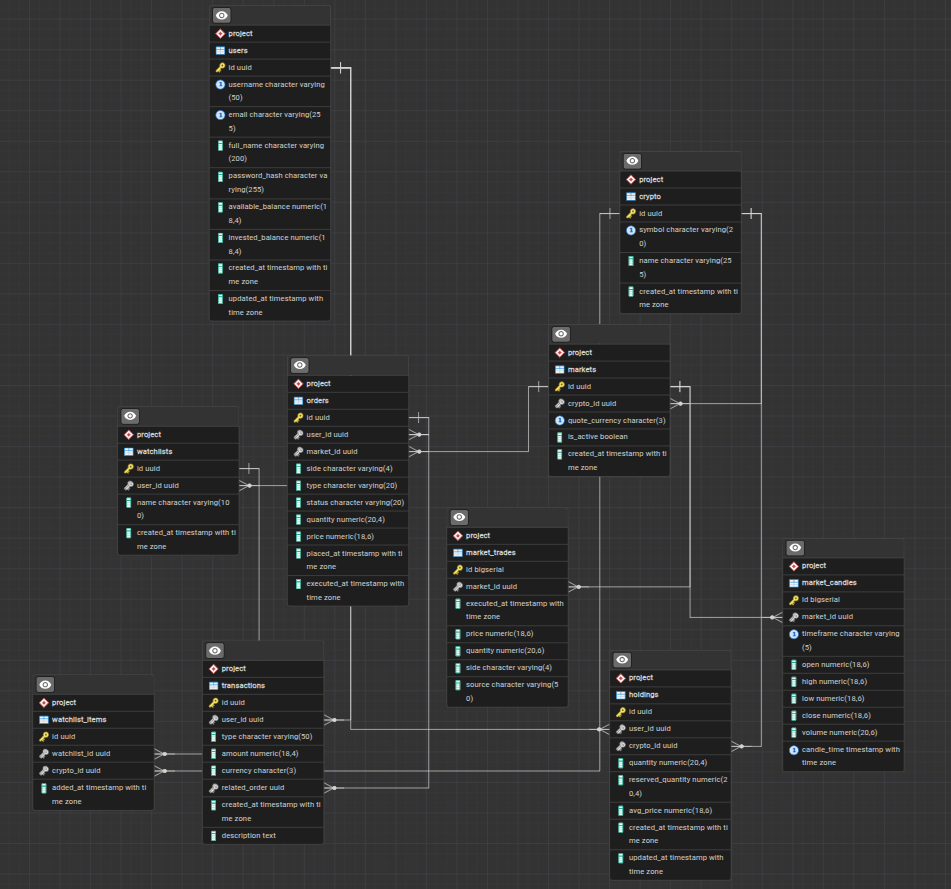
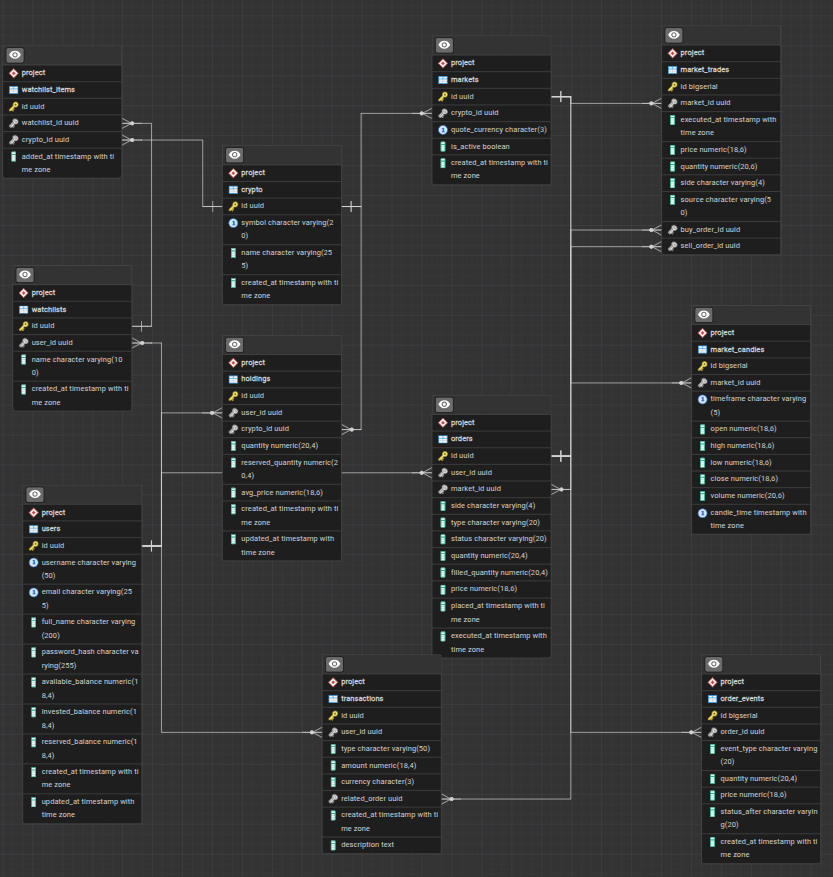
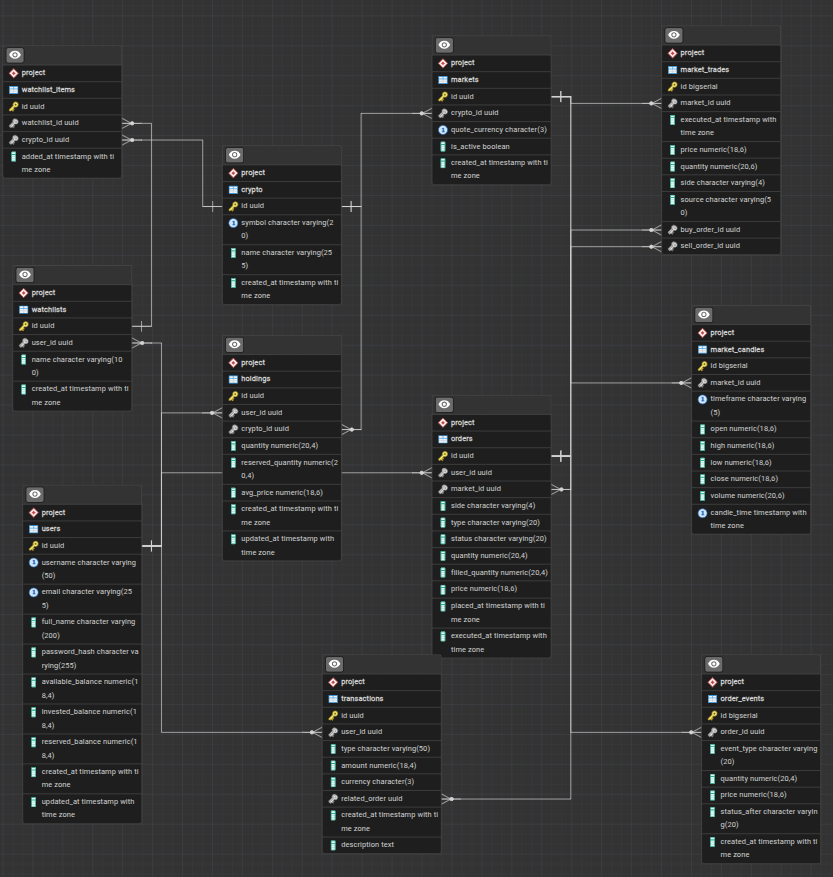
Relational diagram

Generated in Pgadmin from the live project schema, in crow's-foot
notation — not drawn by hand, so it is evidence that the deployed database
actually matches the design described above. Each box is a table with its
columns and declared types; key icons mark primary keys and the arrowed lines
are the 12 declared foreign keys.
How to regenerate it
With pgAdmin 4, if DBeaver is unavailable — it reads the live schema the same way, so the result is equivalent in substance:
- Connect to the project database.
- Right-click the database → ERD For Database (or open a blank ERD and drag
the
projecttables in). - Arrange the tables to mirror
ERModel_v03.png. - Download image → PNG, then convert:
convert relational_schema.png relational_schema.jpg
Attachments (3)
- relational_schema_v2.png (208.0 KB ) - added by 3 days ago.
- Screenshot from 2026-09-24 17-18-53.png (197.7 KB ) - added by 2 days ago.
- relational_schema_v3.png (197.7 KB ) - added by 2 days ago.
Download all attachments as: .zip