Conceptual Model
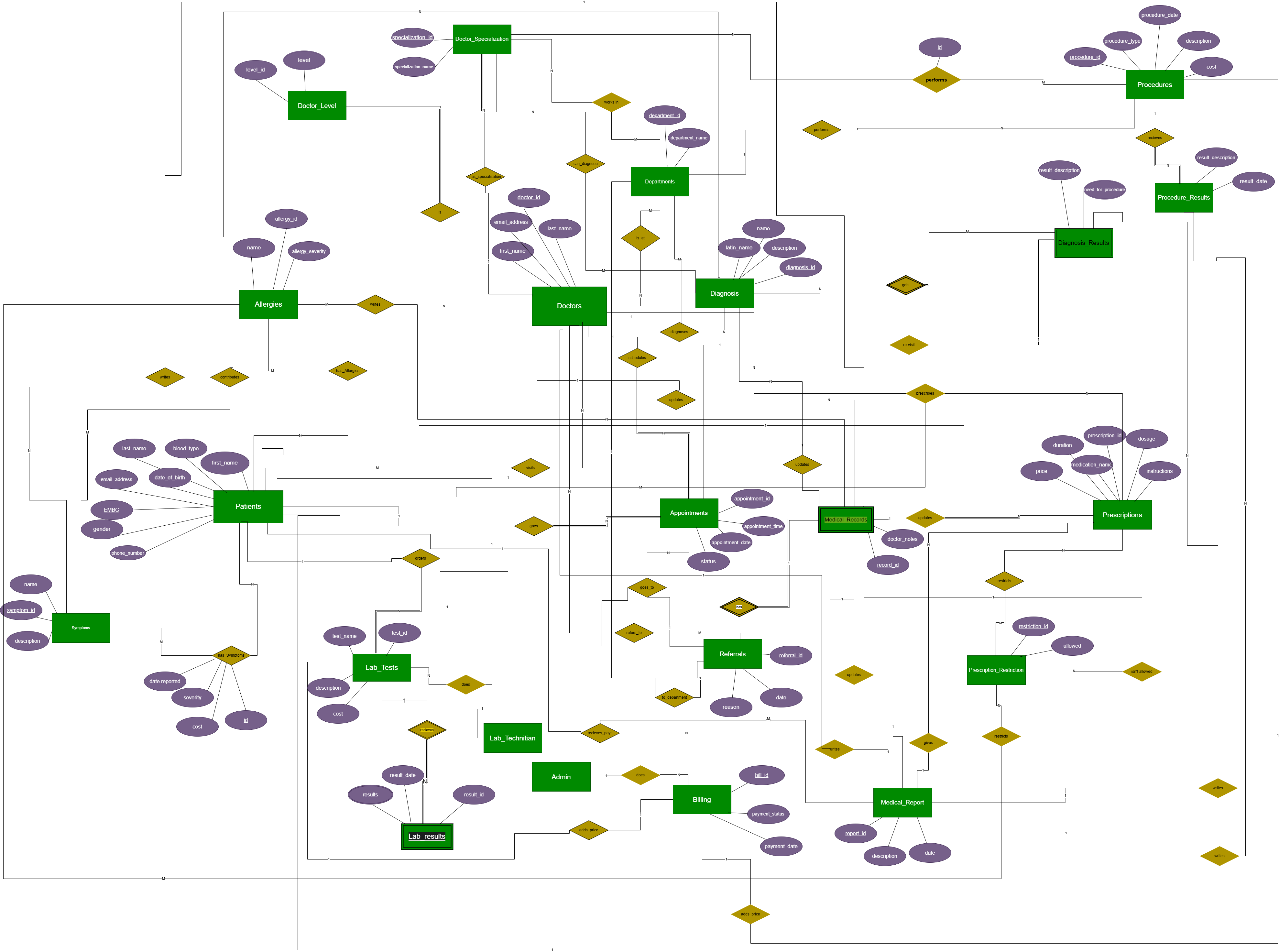
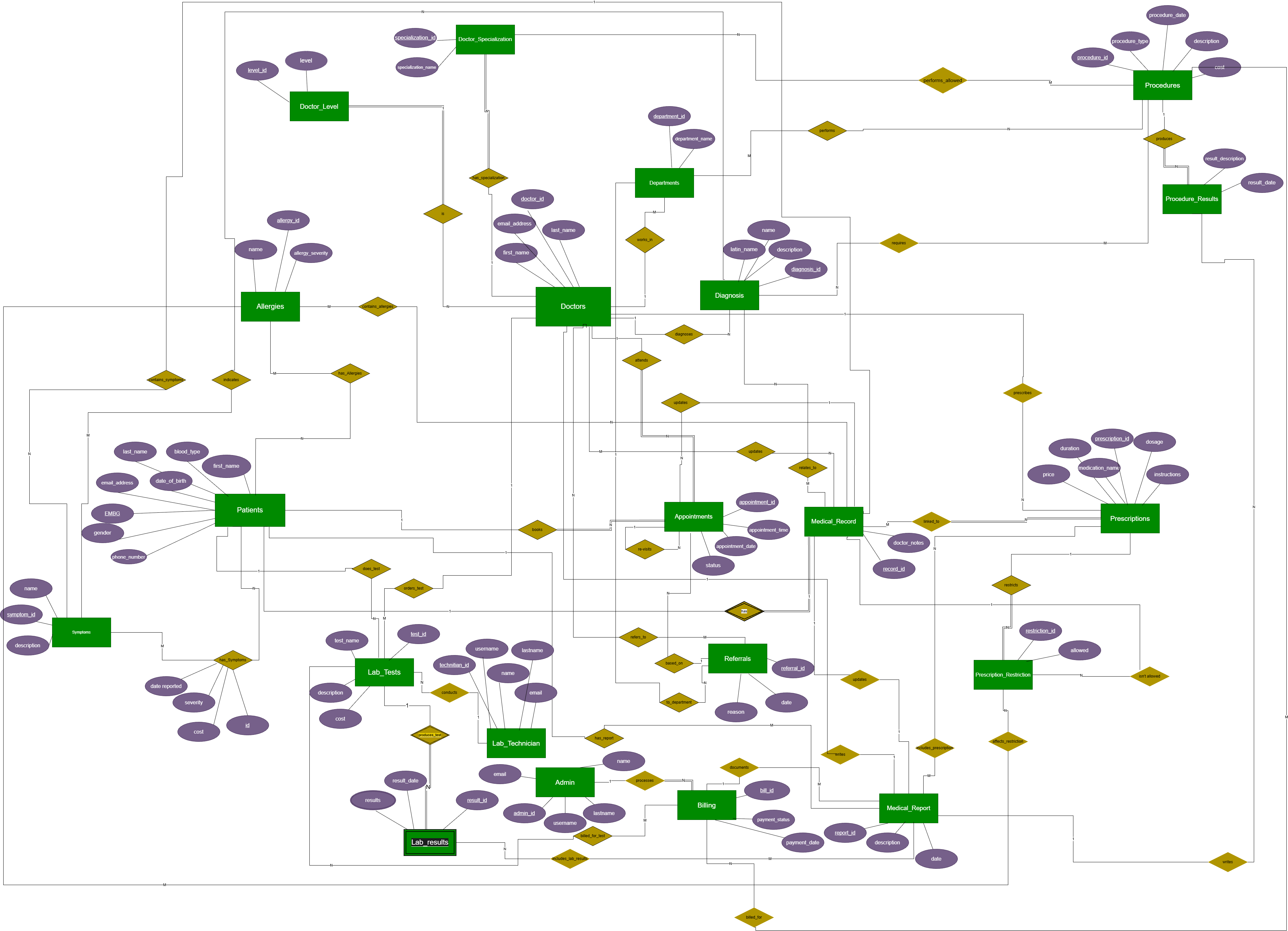
ER Diagram

Data requirements
Entities
- Doctor_Level – entity that stores doctor levels
- level_id (PK, bigint)
- level (text)
- Doctor_Specialization – entity that stores doctor specializations
- specialization_id (PK, bigint)
- specialization_name (text)
- Departments – entity that stores hospital departments
- department_id (PK, bigint)
- department_name (text)
- Doctors – entity that stores doctors
- doctor_id (PK, bigint)
- first_name (text)
- last_name (text)
- email_address (text)
- level_id (FK, bigint)
- specialization_id (FK, bigint)
- department_id (FK, bigint)
- Admin – entity that stores administrator data
- admin_id (PK, bigint)
- username (text)
- name (text)
- lastname (text)
- email (text)
- Lab_Technician – entity that stores lab technician data
- technician_id (PK, bigint)
- username (text)
- name (text)
- lastname (text)
- email (text)
- Patients – entity that stores patients
- patient_id (PK, bigint)
- first_name (text)
- last_name (text)
- email_address (text)
- date_of_birth (date)
- blood_type (text)
- gender (text)
- phone_number (text)
- EMBG (text)
- Allergies – entity that stores allergies
- allergy_id (PK, bigint)
- name (text)
- allergy_severity (text)
- Symptoms – entity that stores symptoms
- symptom_id (PK, bigint)
- name (text)
- description (text)
- Appointments – entity that stores appointments
- appointment_id (PK, bigint)
- appointment_date (date)
- appointment_time (time)
- status (text)
- patient_id (FK, bigint)
- doctor_id (FK, bigint)
- Diagnosis – entity that stores diagnoses
- diagnosis_id (PK, bigint)
- name (text)
- description (text)
- patient_id (FK, bigint)
- doctor_id (FK, bigint)
- Procedures – entity that stores medical procedures
- procedure_id (PK, bigint)
- procedure_type (text)
- procedure_date (date)
- description (text)
- cost (decimal)
- doctor_id (FK, bigint)
- diagnosis_id (FK, bigint)
- Procedure_Results – entity that stores procedure results
- result_id (PK, bigint)
- result_description (text)
- result_date (date)
- procedure_id (FK, bigint)
- Prescriptions – entity that stores prescriptions
- prescription_id (PK, bigint)
- medication_name (text)
- dosage (text)
- instructions (text)
- duration (text)
- price (decimal)
- doctor_id (FK, bigint)
- patient_id (FK, bigint)
- Prescription_Restriction – entity that stores prescription restrictions
- restriction_id (PK, bigint)
- allowed (boolean)
- prescription_id (FK, bigint)
- Lab_Tests – entity that stores lab tests
- test_id (PK, bigint)
- test_name (text)
- description (text)
- cost (decimal)
- patient_id (FK, bigint)
- technician_id (FK, bigint)
- Lab_Results – entity that stores lab results
- result_id (PK, bigint)
- results (text)
- result_date (date)
- test_id (FK, bigint)
- Medical_Records – entity that stores medical records
- record_id (PK, bigint)
- doctor_notes (text)
- patient_id (FK, bigint)
- doctor_id (FK, bigint)
- Referrals – entity that stores referrals
- referral_id (PK, bigint)
- reason (text)
- date (date)
- doctor_id (FK, bigint)
- patient_id (FK, bigint)
- Medical_Report – entity that stores medical reports
- report_id (PK, bigint)
- description (text)
- date (date)
- patient_id (FK, bigint)
- doctor_id (FK, bigint)
- Billing – entity that stores billing information
- bill_id (PK, bigint)
- payment_status (text)
- payment_date (date)
- patient_id (FK, bigint)
Relations
- is (Doctor_Levels ↔ Doctors, 1:N)
Each doctor is assigned one level, while a level can belong to many doctors.
- has_specialization (Doctors ↔ Doctor_Specialization, 1:N)
Each doctor has one specialization, while a specialization can apply to many doctors.
- works_in (Departments ↔ Doctors, 1:N)
Each doctor works in one department, while a department employs many doctors.
- has_allergies (Patients ↔ Allergies, M:N)
Patients can have multiple allergies, and the same allergy can affect many patients.
- contains_allergies (Allergies ↔ Medical_Record, M:N)
A medical record can contain multiple allergies, while the same allergy can appear in multiple medical records.
- affects_prescription (Allergy ↔ Prescription_Restriction, M:N)
An allergy can be associated with multiple prescription restrictions, while the same restriction can apply to multiple allergies.
- has_symptoms (Patients ↔ Symptoms, M:N)
Patients can report multiple symptoms, and each symptom can be reported by many patients.
- indicates (Symptoms ↔ Diagnosis, M:N)
A diagnosis can be associated with multiple symptoms, while the same symptom can appear in multiple diagnoses.
- contains_symptoms (Medical_Record ↔ Symptoms, 1:N)
Each medical record can contain multiple symptoms, while each symptom entry belongs to one medical record.
- books (Patients ↔ Appointments, 1:N)
A patient can book multiple appointments, while each appointment belongs to one patient.
- attends (Doctors ↔ Appointments, 1:N)
A doctor can attend multiple appointments, while each appointment is handled by one doctor.
- updates (Appointment ↔ Medical_Record, 1:N)
An appointment can generate multiple updates in the medical record, while each update is associated with one appointment.
- diagnoses (Doctors ↔ Diagnosis, 1:N)
A doctor can make multiple diagnoses, while each diagnosis is made by one doctor.
- performs_allowed (Doctor_Specialization ↔ Procedure, M:N)
A doctor specialization can be associated with multiple procedures it allows, while the same procedure can be associated with multiple doctor specializations.
- requires (Diagnosis ↔ Procedure, M:N)
A diagnosis can require multiple procedures, while the same procedure can be required by multiple diagnoses.
- produces (Procedure ↔ Procedure_Result, 1:N)
A procedure can produce multiple results, while each result belongs to one procedure.
- performs (Department ↔ Procedure, M:N)
A department can perform multiple procedures, while the same procedure can be performed in multiple departments.
- billed_for (Procedure ↔ Billing, M:N)
A billing record can include multiple procedures, while the same procedure can appear in multiple billing records.
- prescribes (Doctors ↔ Prescriptions, 1:N)
A doctor can write multiple prescriptions, while each prescription is written by one doctor.
- restricts (Prescriptions ↔ Prescription_Restriction, 1:N)
A prescription can have multiple restrictions, while each restriction belongs to one prescription.
- does_test (Patients ↔ Lab_Tests, 1:N)
A patient can take multiple lab tests, while each test belongs to one patient.
- orders_test (Doctors ↔ Lab_Tests, 1:N)
A doctor can order multiple lab tests, while each lab test is ordered by one doctor.
- conducts (Lab_Technician ↔ Lab_Tests, 1:N)
A lab technician can conduct multiple tests, while each test is conducted by one technician.
- produces_test (Lab_Tests ↔ Lab_Results, 1:N)
A lab test can produce multiple results, while each result belongs to one test.
- billed_for_test (LabTest ↔ Billing, M:N)
A billing record can include multiple lab tests, while the same lab test can appear in multiple billing records.
- has (Patient ↔ Medical_Record, 1:1)
Each patient has one medical record, and each medical record belongs to one patient.
- updates (Doctors ↔ Medical_Record, M:N)
Doctors can update multiple medical records, and records can be updated by multiple doctors.
- issues (Doctors ↔ Referral, 1:N)
A doctor can issue multiple referrals, while each referral is issued by one doctor.
- creates (Doctors ↔ Medical_Report, 1:N)
A doctor can create multiple medical reports, while each report is created by one doctor.
- has (Patient ↔ Medical_Report, 1:N)
A patient can have multiple medical reports, while each report belongs to one patient.
- updates (Medical_Record ↔ Medical_Report, 1:N)
A medical record can generate multiple reports, while each report is based on one record.
- isn’t_allowed (Medical_Record ↔ Prescription_Restriction, 1:M)
Each medical record can contain multiple prescription restrictions, while each restriction belongs to one medical record.
- processes (Admin ↔ Billing, 1:N)
An admin can process multiple billing records, while each bill is processed by one admin.
- relates_to (Diagnosis ↔ Medical_Record, M:N)
Diagnoses can relate to multiple medical records, and records can include multiple diagnoses.
- linked_to (Prescription ↔ Medical_Record, M:N)
Prescriptions can be linked to multiple medical records, and records can include multiple prescriptions.
- includes_prescription (Medical_Report ↔ Prescription, M:N)
Medical reports can include multiple prescriptions, and prescriptions can appear in multiple reports.
- includes_lab_results (Medical_Report ↔ Lab_Results, M:N)
Medical reports can include multiple lab results, and results can appear in multiple reports.
- based_on (Referral ↔ Appointment, 1:N)
A referral can serve as the basis for multiple appointments, while each appointment is associated with one referral.
- re_visits (Appointment ↔ Appointment, 1:N)
An appointment can result in multiple follow-up appointments, while each follow-up appointment is associated with one previous appointment.
- documents (Medical_Report ↔ Billing, 1:N)
A medical report can generate multiple billing records, while each billing record is associated with one medical report.
Attachments (2)
-
Hospital_ER_Diagram.drawio.png
(1.0 MB
) - added by 4 months ago.
er_diagram_first
- Hospital_ER_Diagram2.drawio.png (988.8 KB ) - added by 3 months ago.