| Version 3 (modified by , 10 months ago) ( diff ) |
|---|
ERModel Current version
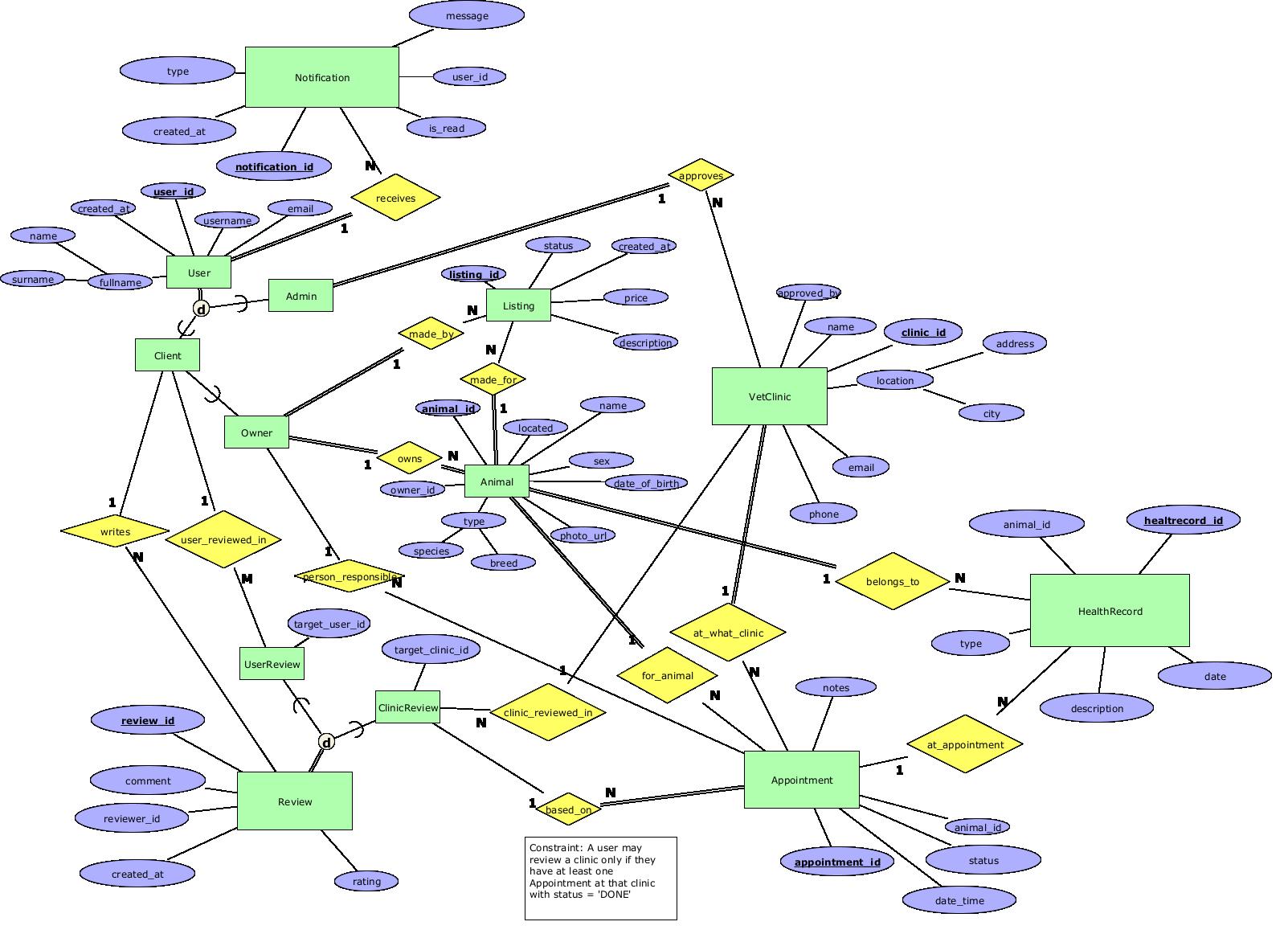
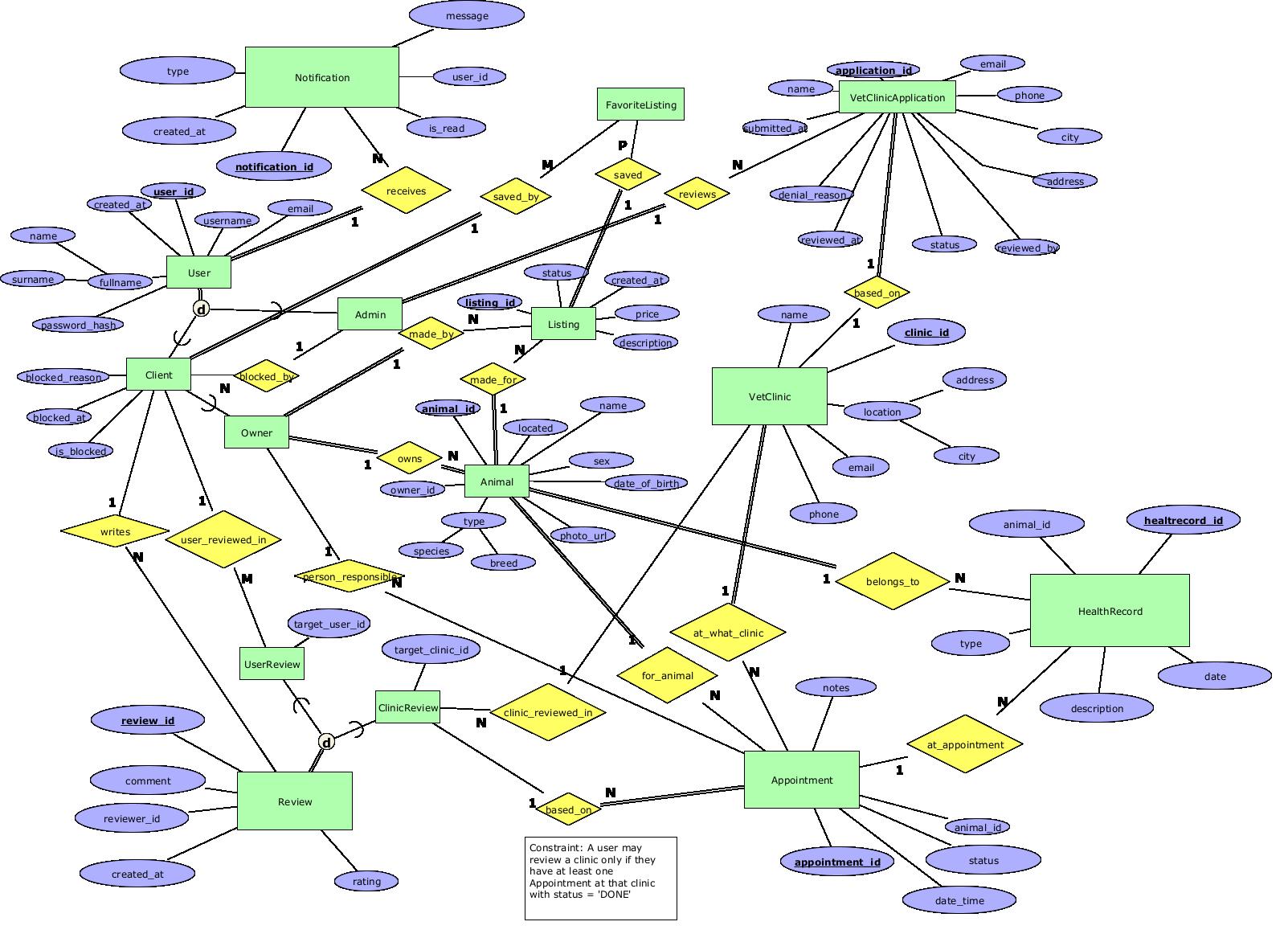
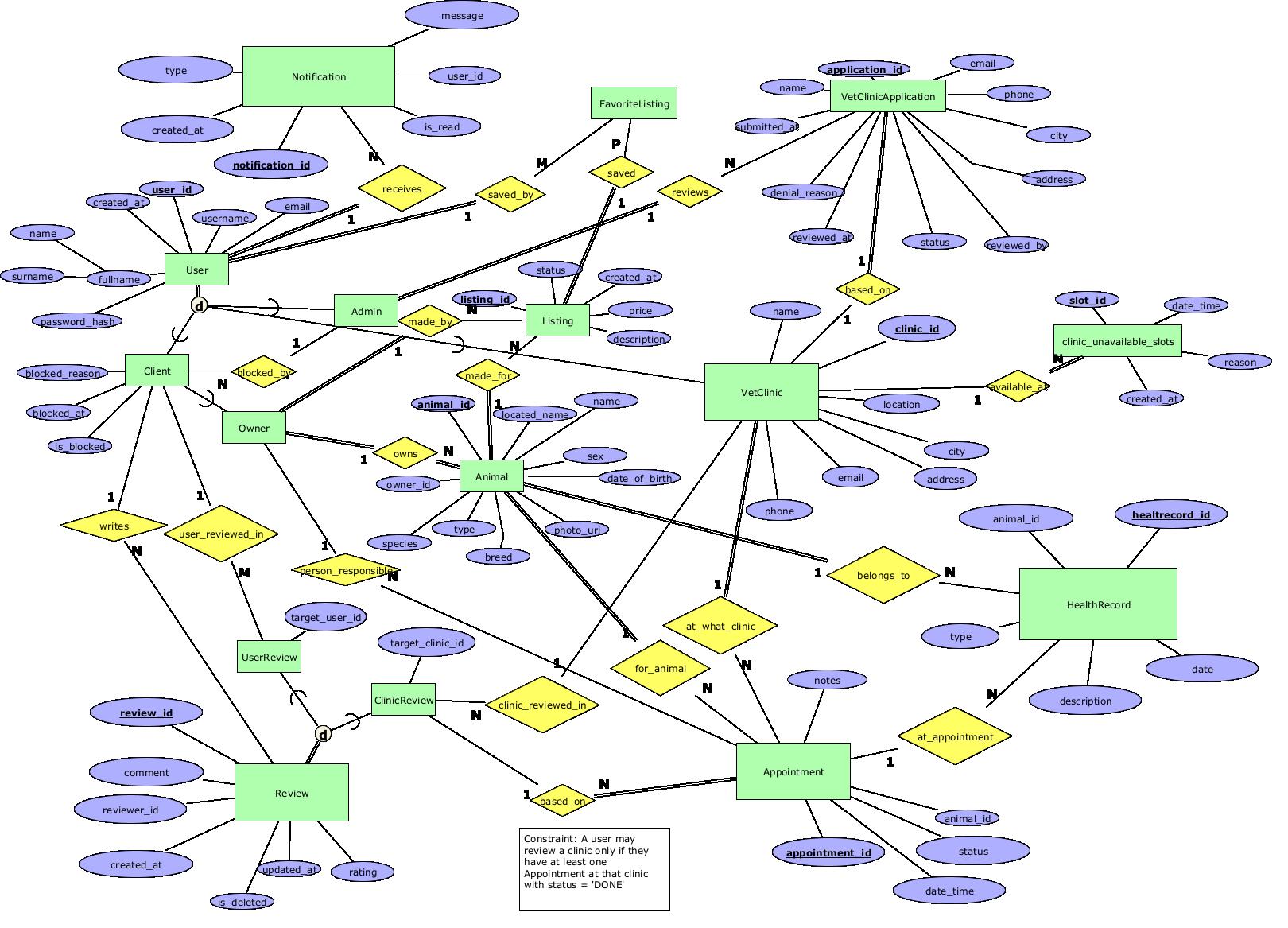
Diagram

Data requirements
ENTITIES
User
Represents every person using the platform: buyers, sellers, and administrators. It is needed to authenticate users, assign roles, and link their actions (listings, reviews, notifications, ownership of animals). It is modeled as a single entity with a role attribute instead of separate tables for buyers/sellers/admins, because one person can play multiple roles over time.
Candidate keys:
user_id– surrogate numeric identifier (chosen primary key).username– natural key, must be unique, but can change in the future.email– also unique, but might change and can be reused if a user is deleted.
user_id is chosen as PK because it is stable, short, and independent of business rules.
Attributes:
user_id– numeric, required. Auto-generated positive integer; primary key.username– text, required. Unique; max length ~30; only letters, digits and some symbols.role– text, required. Limited set of values: {ADMIN, USER, GUEST}; implemented as enum.fullname– text, required. Free-text full name.name– text, required. First name; max length ~50.surname– text, required. Last name; max length ~50.email– text, required. Must be unique; email format validation.created_at– datetime, required. Automatically set when the account is created.
Listing
Represents an advertisement where a user offers an animal for sale. It is needed to separate the offer from the animal itself (the same animal can appear in multiple listings over time, and a user can create many listings). It is modeled with its own status and price attributes because these can change independently of the animal data.
Candidate keys:
listing_id– surrogate numeric identifier (primary key).
No realistic natural key exists that is stable and unique, so we only use listing_id.
Attributes:
listing_id– numeric, required. Auto-generated primary key.status– text, required. Allowed values like {ACTIVE, RESERVED, SOLD}.created_at– datetime, required. Date and time when the listing was created. Automatically set.price– numeric, required. Must be > 0.description– text, optional. Free-text; length limit ~ 1000 characters.
Animal
Represents each individual pet in the system. Needed to track identity, species, breed, owner, and health data independently from listings. It is modeled as a separate entity because health records, appointments, and ownership relate to the animal itself, not just to an advertisement.
Candidate keys:
animal_id– surrogate numeric identifier (primary key).
animal_id is chosen as PK for simplicity and stability.
Attributes:
animal_id– numeric, required. Auto-generated primary key.owner_id– numeric, required. Foreign key to User.user_id; must reference an existing user.species– text, required. Choose from predefined set.type– text, required.breed– text, required. Breed name; may be “mixed/unknown”.status– text, required. Choosed from a predefined set{AVAILABLE,IN_TREATMENT,???}.name– text, required. Pet name; max length ~50.sex– text, required. {MALE, FEMALE, UNKNOWN}.date_of_birth– date, required. Must not be in the future.located– text, required. City/area; free text.photo_url– text, required. URL to main photo; must be valid URL format.
VetClinic
Represents veterinary clinics that cooperate with the platform. It is needed so animals, appointments, and reviews can be associated with a specific clinic. It is modeled as a separate entity because clinics are independent organizational units with their own attributes and can be referenced by many animals, appointments, and reviews.
Candidate keys:
clinic_id– surrogate numeric identifier (primary key).name + addresscould be a natural key, but both may change over time, so they are not used as the primary key.
clinic_id is chosen as PK for stability, simplicity, and immutability.
Attributes:
clinic_id– numeric, required. Auto-generated primary key.name– text, required. Clinic name; max length ~100.location– text, required. Region or district name.address– text, optional. Street address; max length ~200.city– text, required.email– text, optional. Must be valid email format; must be unique.phone– text, optional. May require a specific phone-number format.
Appointment
Represents a scheduled veterinary visit for a specific animal. Required to organize veterinary care, track upcoming visits, and link visits to clinics and generated health records. It is modeled as a standalone entity because appointments are time-based events that may create one or more medical entries.
Candidate keys:
appointment_id– surrogate numeric identifier (primary key).- A composite natural key like (
animal_id,date_time,clinic_id) could be considered, but it is complex and not guaranteed unique.
appointment_id is chosen as the PK because it is simple, stable, and unambiguous.
Attributes:
appointment_id– numeric, required. Auto-generated primary key.date_time– datetime, required. Must represent a valid future or past appointment date.status– text, required. Allowed values: {SCHEDULED, COMPLETED, CANCELLED, NO_SHOW}.notes– text, optional. Additional remarks from the owner or vet.
HealthRecord
Represents a single medical action or observation (vaccination, treatment, surgery, deworming, check-up) recorded for a specific animal. It is required to maintain a complete medical history. Modeled as its own entity because multiple medical actions may occur within one appointment, and each animal can accumulate records over its lifetime.
Candidate keys:
healthrecord_id– surrogate numeric identifier (primary key).- A possible natural key (
animal_id,date,type) is not reliable because multiple actions of the same type may occur on the same day.
healthrecord_id is chosen as PK for simplicity and uniqueness.
Attributes:
healthrecord_id– numeric, required. Auto-generated primary key.animal_id– numeric, required. Foreign key to Animal.animal_id.type– text, required. Allowed values include {VACCINATION, SURGERY, DEWORMING, CHECKUP}.description– text, optional. Details of the treatment or observation.date– date, required. Must be a valid date; must not be in the future for completed actions.
Review
Represents feedback written by a user about either another user (e.g., a seller) or a veterinary clinic. It is essential for trust, transparency, and reputation. It is modeled with two optional foreign keys — target_user_id and target_clinic_id — so that a single structure supports reviewing people and organizations. A design constraint ensures that at least one of them must be non-null.
Candidate keys:
review_id– surrogate numeric identifier (primary key).- A compound natural key such as (
reviewer_id,target_user_id,created_at) is possible but not guaranteed unique.
review_id is chosen as PK for simplicity and consistency.
Attributes:
review_id– numeric, required. Auto-generated primary key.comment– text, optional. Free-text comment; up to ~1000 characters.reviewer_id– numeric, required. Foreign key to User.user_id.target_user_id– numeric, optional. FK to User.user_id. Must be non-null when review is about a user.target_clinic_id– numeric, optional. FK to VetClinic.clinic_id. Must be non-null when review is about a clinic.created_at– datetime, required. Time of submission.rating– numeric, required. Integer 1–5; enforce interval [1, 5].
Special constraint:
At least one of target_user_id or target_clinic_id must be NOT NULL (exactly one in normal operation).
Notification
Represents a system-generated message delivered to a user (e.g., appointment reminders, listing updates, new reviews). It is necessary for timely communication and platform usability. It is modeled as an entity linked to a single user because each notification is specific to one recipient.
Candidate keys:
notification_id– surrogate numeric identifier (primary key).
No natural candidate key exists because notifications are numerous and non-unique.
notification_id is chosen as a primary key.
Attributes:
notification_id– numeric, required. Auto-generated primary key.type– text, required. Allowed values include {APPOINTMENT_REMINDER, NEW_REVIEW, LISTING_STATUS}.created_at– datetime, required. When the notification was generated.message– text, required. Human-readable notification body.user_id– numeric, required. Foreign key to User.user_id (recipient).is_read– boolean, required. Defaults to FALSE; becomes TRUE when viewed.
ERModel History
Attachments (5)
- ERModel_v01.png (164.1 KB ) - added by 10 months ago.
- ERModel_v01.2.png (164.1 KB ) - added by 10 months ago.
- ERModel_v02.jpg (204.3 KB ) - added by 10 months ago.
- ERModel_v03.jpg (245.4 KB ) - added by 7 months ago.
- ERModel_v04.jpg (256.8 KB ) - added by 5 months ago.
Download all attachments as: .zip