| Version 1 (modified by , 4 days ago) ( diff ) |
|---|
Use-case 0001 Implementation - Register new account
Initiating actor: Visitor
Other actors: —
A new person creates an account on EduBerza so that they can later log in as a
Trader (UseCase0002). The Visitor enters a
username, an e-mail address, a full name and a password. The system validates the
input (required fields, an @ in the e-mail, a password of at least 6 characters),
refuses a username or e-mail that is already registered, and stores only a SHA-256
hash of the password, never the password itself. A new account starts with a cash
balance of 0 USD; money is added later with a deposit
(UseCase0003).
Original use-case description (P3): UseCase0001.
Implementation: server/auth.go, function Register (the password hash is computed
by hashPassword in the same file; the code is shown at the end of this page).
Scenario
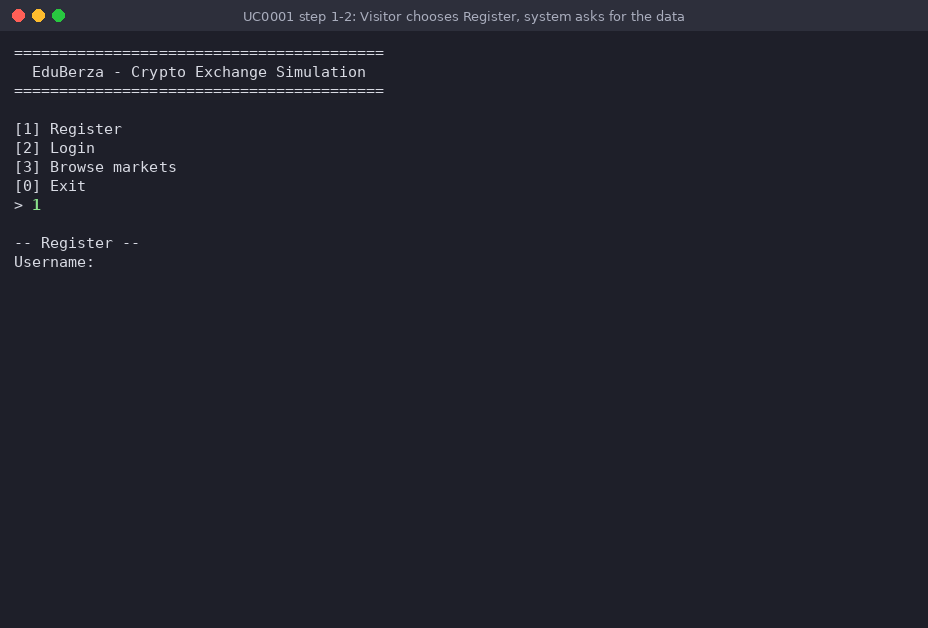
- Visitor chooses
[1] Registerin the anonymous menu (types1). - System prints
-- Register --and asks, one prompt after another, forUsername:,Email:,Full name:andPassword (min 6 chars):.
The screenshot shows steps 1–2: option 1 is chosen and the first prompt
(Username:) is waiting for input.

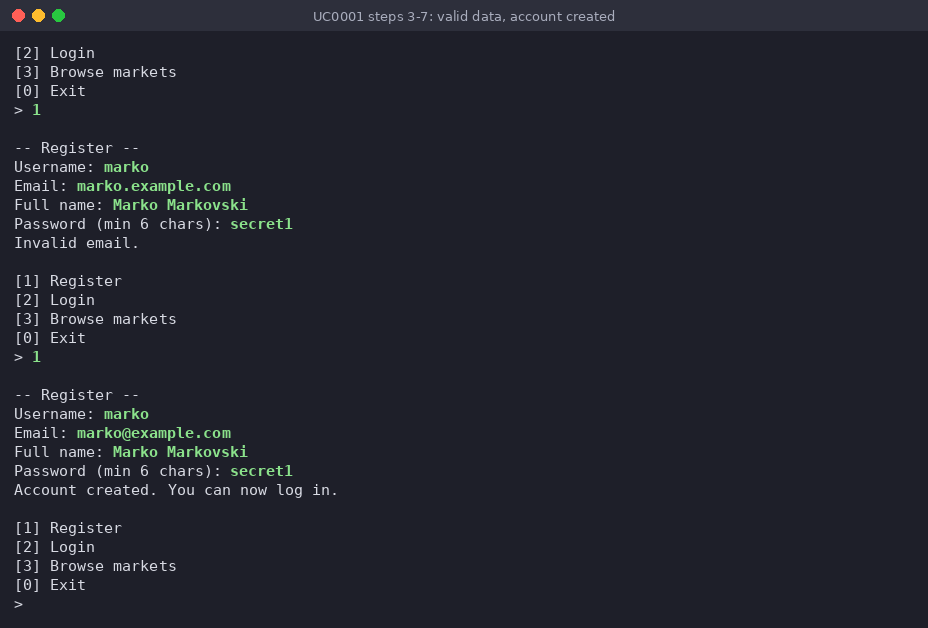
- Visitor enters the values:
marko,marko@example.com,Marko Markovski,secret1. - System validates the input in Go, without accessing the database:
- username, e-mail and password must be non-empty, otherwise it prints
Username, email and password are required.and the scenario ends; - the e-mail must contain
@(see alternate flow 3a); - the password must be at least 6 characters long, otherwise it prints
Password must be at least 6 characters.and the scenario ends.
- username, e-mail and password must be non-empty, otherwise it prints
- System checks whether the username or the e-mail already exists
(
$1= username,$2= e-mail):
SELECT EXISTS(SELECT 1 FROM users WHERE username = $1 OR email = $2)
If the result is true, alternate flow 5a applies.
- System creates the account (
$1= username,$2= e-mail,$3= full name,$4= password hash). The hash is computed in Go byhashPasswordas the hex-encoded SHA-256 of the password — the same value that P3'sencode(digest($4, 'sha256'), 'hex')would produce in SQL. Hashing on the Go side keeps it identical to the check done at login (SQL as in the code, only the Go source indentation removed):
INSERT INTO users (username, email, full_name, password_hash, available_balance)
VALUES ($1, $2, $3, $4, 0)
- System prints
Account created. You can now log in.and returns to the anonymous menu; the Visitor can continue with UseCase0002.
The screenshot shows steps 3–7 of the successful attempt (bottom half): the entered values, the confirmation and the anonymous menu again. The top half is the earlier rejected attempt from alternate flow 3a.

All statements are run on the project schema: the connection sets
search_path=project,public (server/db/db.go), so users means project.users.
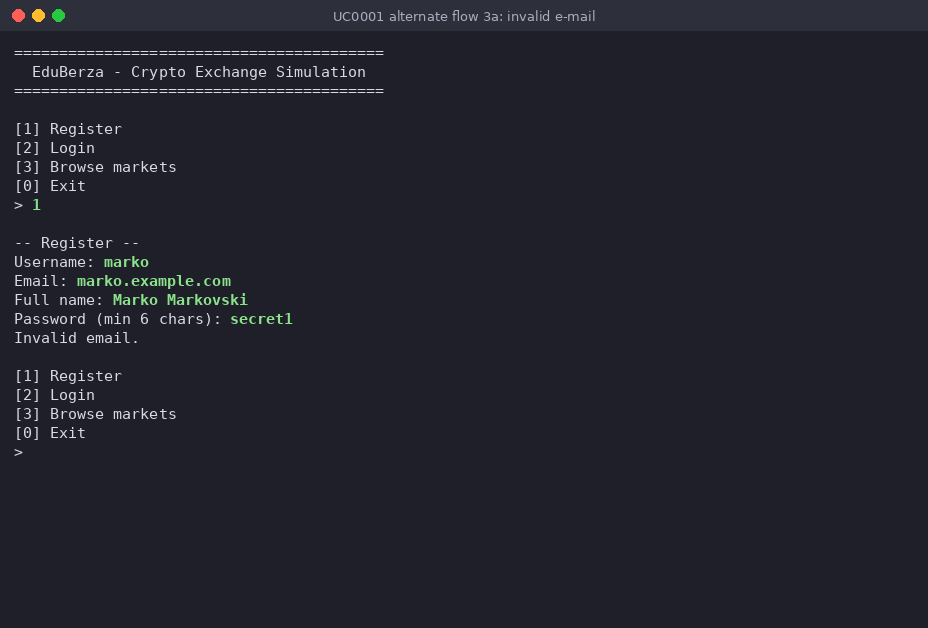
Alternate flow 3a — invalid e-mail
In step 3 the Visitor entered marko.example.com (no @). The check in step 4
fails, the system prints Invalid email. and no SQL statement is executed. In the
prototype the system then shows the anonymous menu again and the Visitor chooses
[1] Register once more, which returns the scenario to step 2.

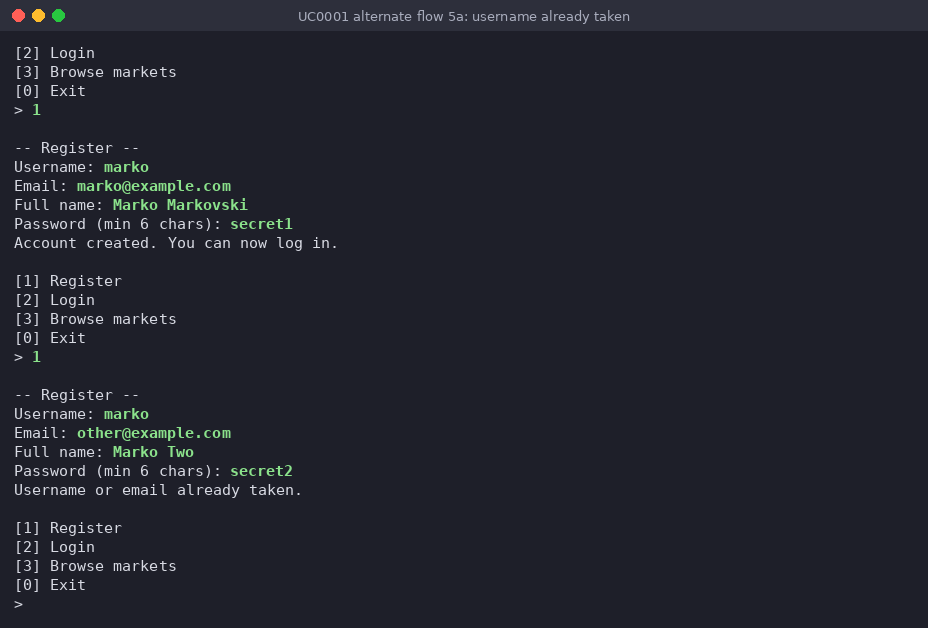
Alternate flow 5a — duplicate username or e-mail
After marko has been created, the Visitor tries to register again with username
marko, e-mail other@example.com, full name Marko Two, password secret2. The
query from step 5 ($1 = marko, $2 = other@example.com) returns true
because the username is taken, so the system prints
Username or email already taken., does not run the INSERT, and the scenario
ends in the anonymous menu.

How to reproduce
./eduberza -init      # optional: reset to a known state
./eduberza
# [1] Register: marko / marko.example.com / Marko Markovski / secret1  -> Invalid email.
# [1] Register: marko / marko@example.com / Marko Markovski / secret1  -> Account created.
# [1] Register: marko / other@example.com / Marko Two / secret2        -> Username or email already taken.
All three screenshots come from one real run of exactly these inputs.
Source code
server/auth.go — hashPassword and Register:
func hashPassword(pw string) string {
	sum := sha256.Sum256([]byte(pw))
	return hex.EncodeToString(sum[:])
}

// Register - UC0001
func Register() {
	fmt.Println("\n-- Register --")
	username := prompt("Username: ")
	email := prompt("Email: ")
	fullName := prompt("Full name: ")
	pw := prompt("Password (min 6 chars): ")

	if username == "" || email == "" || pw == "" {
		fmt.Println("Username, email and password are required.")
		return
	}
	if !strings.Contains(email, "@") {
		fmt.Println("Invalid email.")
		return
	}
	if len(pw) < 6 {
		fmt.Println("Password must be at least 6 characters.")
		return
	}

	var exists bool
	err := db.DB.QueryRow(
		`SELECT EXISTS(SELECT 1 FROM users WHERE username = $1 OR email = $2)`,
		username, email,
	).Scan(&exists)
	if err != nil {
		fmt.Println("Database error:", err)
		return
	}
	if exists {
		fmt.Println("Username or email already taken.")
		return
	}

	_, err = db.DB.Exec(
		`INSERT INTO users (username, email, full_name, password_hash, available_balance)
		 VALUES ($1, $2, $3, $4, 0)`,
		username, email, fullName, hashPassword(pw),
	)
	if err != nil {
		fmt.Println("Failed to register:", err)
		return
	}
	fmt.Println("Account created. You can now log in.")
}
Attachments (4)
-
uc0001_1_register.png
(18.4 KB
) - added by 4 days ago.
Registration
- uc0001_3_7_created.png (44.3 KB ) - added by 4 days ago.
- uc0001_3a_invalid_email.png (31.2 KB ) - added by 4 days ago.
- uc0001_5a_duplicate.png (45.6 KB ) - added by 4 days ago.
Download all attachments as: .zip