Use-case 0002 Implementation - Log in
Initiating actor: Visitor
Other actors: —
A registered user authenticates with a username and password so that the system
treats all following actions as actions of that Trader. The system looks the user up
by username and compares the stored password hash with the SHA-256 hash of the
entered password. An unknown username and a wrong password give the same answer,
Invalid credentials., so the system does not reveal which usernames exist. After a
successful login the user's id and username are kept in the in-process session and
the authenticated (Trader) menu is shown, from which all other Trader use-cases
start.
Original use-case description (P3): UseCase0002.
Implementation: server/auth.go, functions Login and authenticate (password hash
by hashPassword; the code is shown at the end of this page).
Scenario
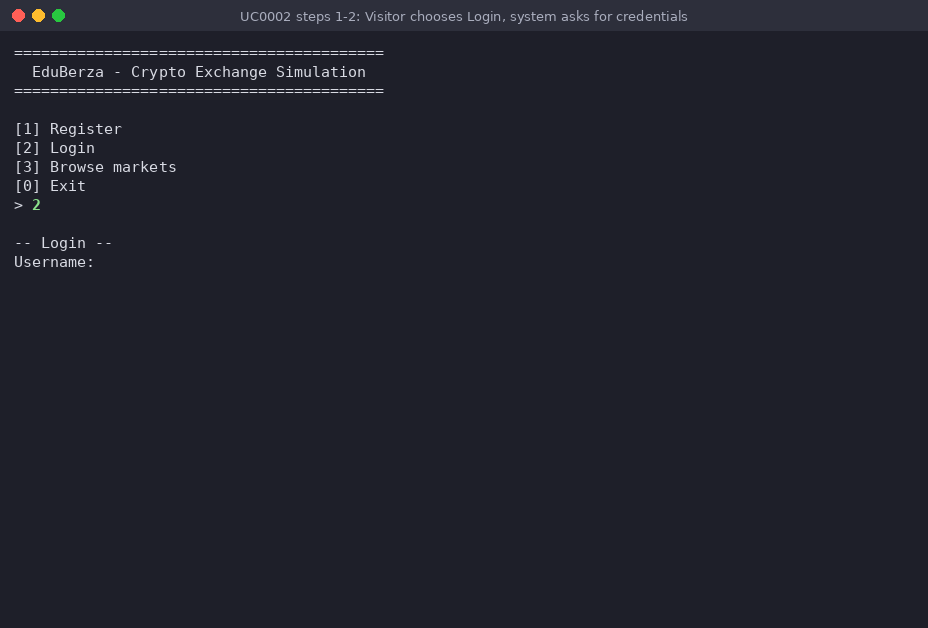
- Visitor chooses
[2] Loginin the anonymous menu (types2). - System prints
-- Login --and asks forUsername:and thenPassword:.
The screenshot shows steps 1–2: option 2 is chosen and the Username: prompt
is waiting for input.

- Visitor enters the username and the password. (If either is empty, the
system prints
Username and password are required.without accessing the database.) - System looks up the user (
$1= entered username):
SELECT id, password_hash FROM users WHERE username = $1
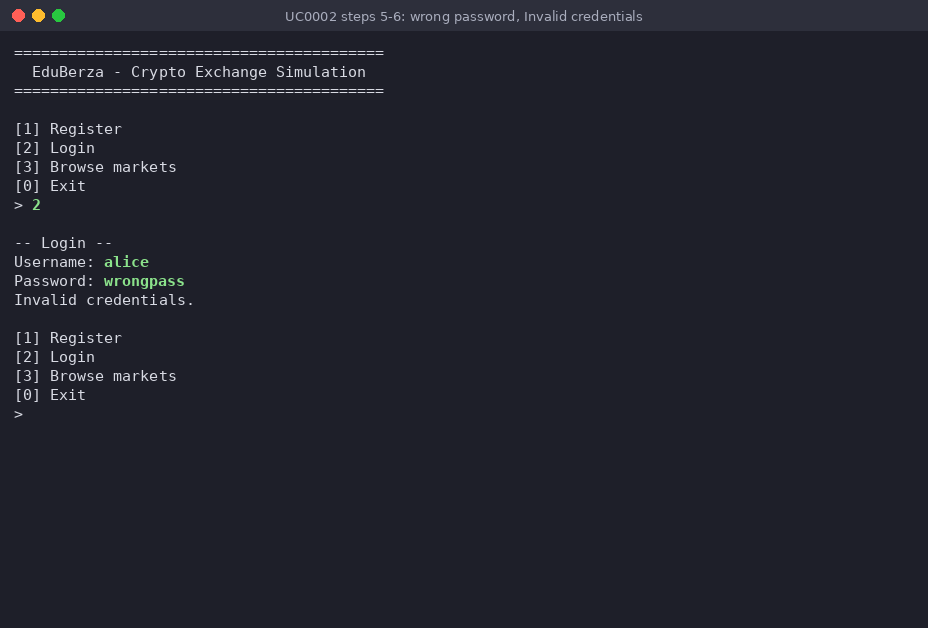
- If no row is returned (
sql.ErrNoRowsin Go), the System respondsInvalid credentials.and the scenario ends. - If a row is returned, the System compares the returned
password_hashwithhashPassword(entered password)(hex-encoded SHA-256, computed in Go). On a mismatch it respondsInvalid credentials.and the scenario ends.
The screenshot shows this failure path with an existing user and a wrong
password: alice / wrongpass. The query from step 4 finds alice's row, the
hash comparison of step 6 fails, and the system prints Invalid credentials. and
returns to the anonymous menu. (An unknown username — step 5 — prints exactly the
same message.)

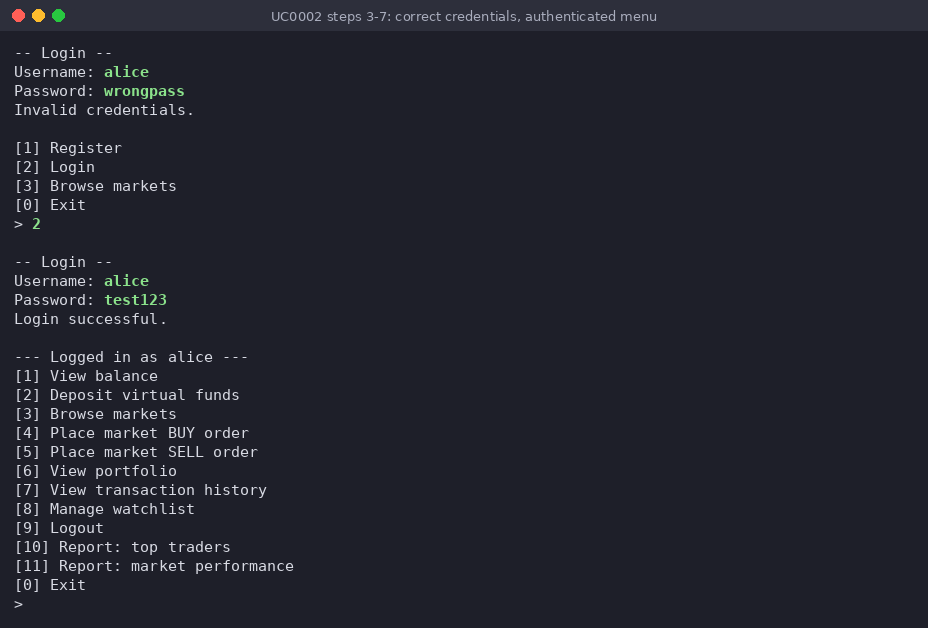
- On a match, the System stores the returned
idand the username in the session (s.UserID,s.Username), printsLogin successful.and displays the authenticated menu headed--- Logged in as alice ---.
The screenshot shows steps 3–7 of the second, successful attempt with the seed
credentials alice / test123 (the first, rejected attempt is still visible at
the top of the window).

The query runs on the project schema (the connection sets
search_path=project,public), so users means project.users.
Alternate flow 4a (P3) — lookup combined with the live balance
P3 describes an optional variant that checks the password in SQL and returns the
balances in the same query. The P4 prototype does not use it: login always uses
the query from step 4 with the hash comparison in Go, and the balances are read
separately when the Trader asks for them ([1] View balance, see
UseCase0003).
Seed credentials
State after ./eduberza -init (server/db/data_load.sql):
| Username | Password | Available balance | Invested balance | Holdings |
|---|---|---|---|---|
alice | test123 | 8250.00 USD | 1750.00 USD | 0.5 ETH |
bob | test123 | 5000.00 USD | 0.00 USD | — |
charlie | test123 | 2500.00 USD | 0.00 USD | — |
How to reproduce
./eduberza -init
./eduberza
# [2] Login: alice / wrongpass  -> Invalid credentials.
# [2] Login: alice / test123    -> Login successful.  (authenticated menu)
The screenshots come from one real run of exactly these inputs.
Source code
server/auth.go — hashPassword, Login and authenticate:
func hashPassword(pw string) string {
	sum := sha256.Sum256([]byte(pw))
	return hex.EncodeToString(sum[:])
}
// Login - UC0002
func Login(s *Session) {
	fmt.Println("\n-- Login --")
	username := prompt("Username: ")
	pw := prompt("Password: ")
	if username == "" || pw == "" {
		fmt.Println("Username and password are required.")
		return
	}

	id, err := authenticate(username, pw)
	if err != nil {
		if errors.Is(err, errInvalidCreds) {
			fmt.Println("Invalid credentials.")
			return
		}
		fmt.Println("Login error:", err)
		return
	}
	s.UserID = id
	s.Username = username
	fmt.Println("Login successful.")
}

var errInvalidCreds = errors.New("invalid credentials")

func authenticate(username, pw string) (string, error) {
	var id, stored string
	err := db.DB.QueryRow(
		`SELECT id, password_hash FROM users WHERE username = $1`,
		username,
	).Scan(&id, &stored)
	if err == sql.ErrNoRows {
		return "", errInvalidCreds
	}
	if err != nil {
		return "", err
	}
	if stored != hashPassword(pw) {
		return "", errInvalidCreds
	}
	return id, nil
}
Attachments (3)
- uc0002_1_login.png (18.0 KB ) - added by 4 weeks ago.
- uc0002_5_6_invalid.png (27.6 KB ) - added by 4 weeks ago.
- uc0002_7_success.png (47.9 KB ) - added by 4 weeks ago.
Download all attachments as: .zip