Use-case 0003 Implementation - Deposit virtual funds
Initiating actor: Trader
Other actors: —
A logged-in Trader tops up their virtual cash balance in USD. This is a
simulation-only operation: no real money changes hands, the amount is simply added to
the Trader's available_balance. Every deposit is also recorded in the ledger
(transactions) so that it appears in the transaction history
(UseCase0006). The operation writes to two tables —
the user row and the ledger — inside a single database transaction, so either both
changes are stored or neither is. Non-numeric, zero or negative amounts are rejected
before the database is touched.
Original use-case description (P3): UseCase0003.
Implementation: server/account.go, function Deposit; the verification uses
ShowBalance from the same file (the code is shown at the end of this page).
Precondition: the Trader is logged in (UseCase0002);
in the run below as alice, who starts from the seed state (available 8250.00 USD,
invested 1750.00 USD).
Scenario
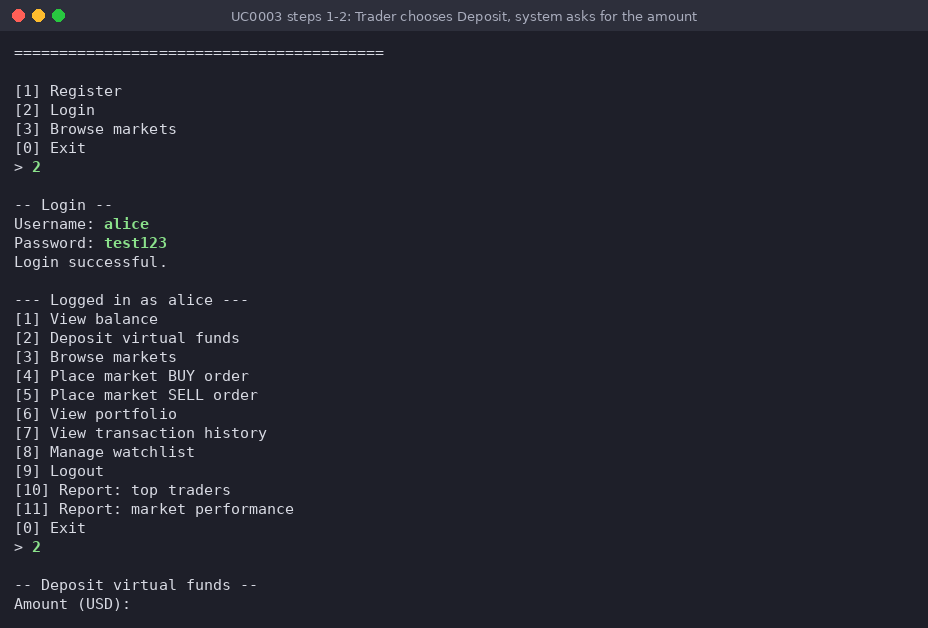
- Trader chooses
[2] Deposit virtual fundsin the authenticated menu (types2). - System prints
-- Deposit virtual funds --and asksAmount (USD):.
The screenshot shows steps 1–2: the login as alice, the authenticated menu, the
choice 2 and the amount prompt waiting for input.

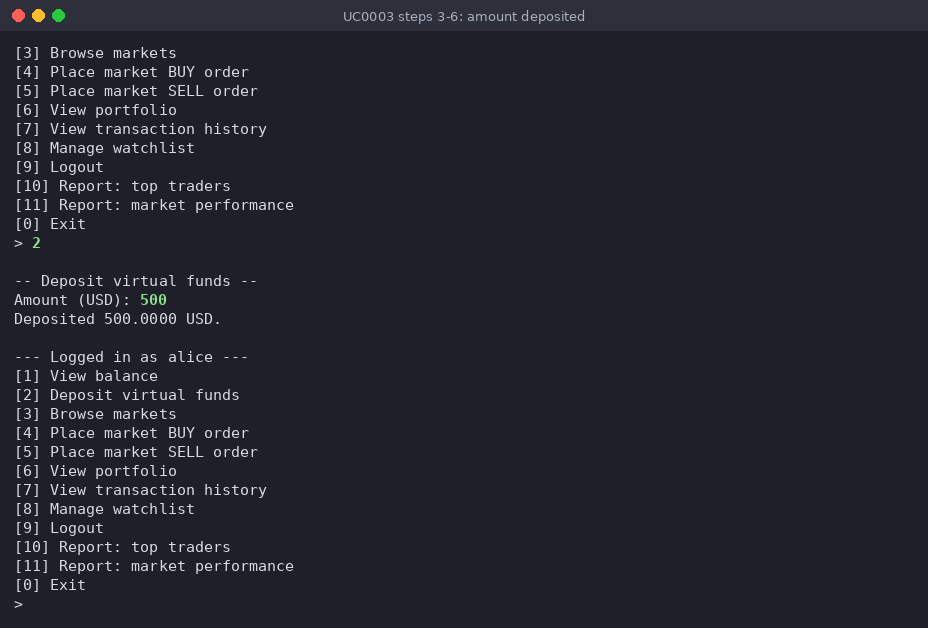
- Trader enters an amount:
500. - System validates the input in Go, without accessing the database: the text
must parse as a number (
strconv.ParseFloat) and be greater than 0 (see alternate flow 4a). - System opens one database transaction (
db.DB.Begin()), increments the balance, writes the ledger row and commits. Both statements run in this single transaction; if either fails, the deferredtx.Rollback()undoes everything.BEGINandCOMMITare issued by Go'sBegin()/Commit(); the two statements are sent exactly as in the code:
BEGIN;

UPDATE users
    SET available_balance = available_balance + $1,
        updated_at        = now()
  WHERE id = $2;

INSERT INTO transactions (user_id, type, amount, currency, description)
VALUES ($1, 'deposit', $2, 'USD', 'Virtual deposit');

COMMIT;
Parameters: placeholders are numbered per statement. In the UPDATE, $1 is the
amount (500) and $2 the user id (amt, s.UserID); in the INSERT it is the
other way round, $1 is the user id and $2 the amount (s.UserID, amt),
matching the column order.
- System confirms
Deposited 500.0000 USD.and returns to the authenticated menu.
The screenshot shows steps 3–6: the entered amount 500, the confirmation and the
authenticated menu again.

The statements run on the project schema (the connection sets
search_path=project,public), so users and transactions mean project.users
and project.transactions.
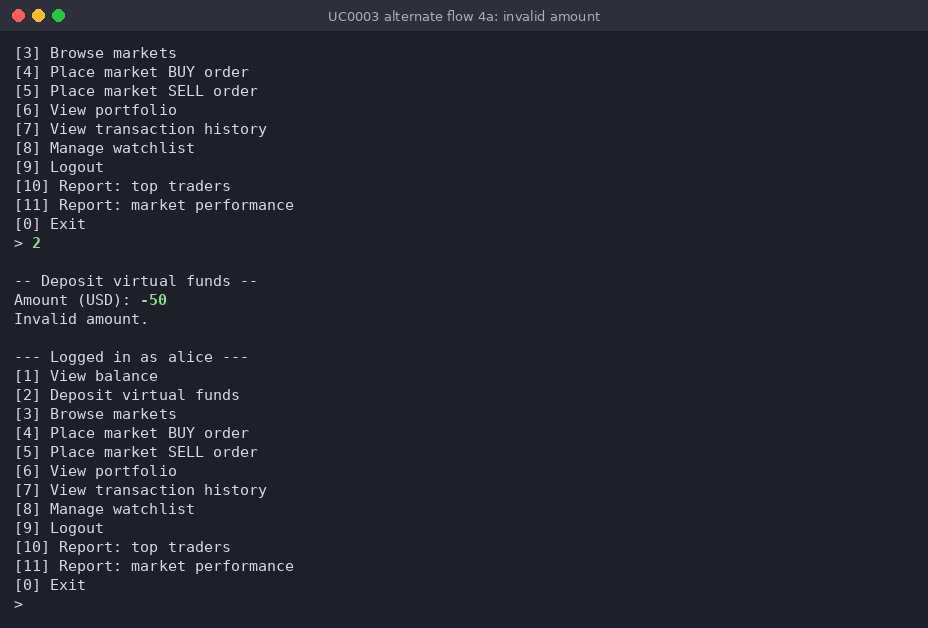
Alternate flow 4a — invalid amount
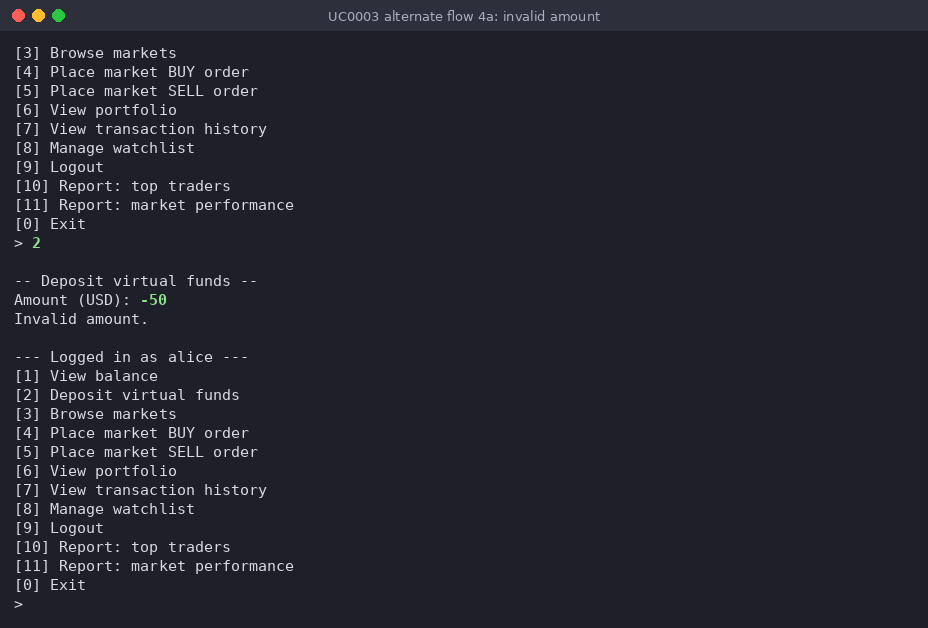
If the amount is not a number, or is zero or negative, the system prints
Invalid amount.; no transaction is started and nothing is written. In the run the
Trader first entered -50. In the prototype the system then shows the
authenticated menu again and the Trader chooses [2] Deposit virtual funds once
more, which returns the scenario to step 2.

Verification
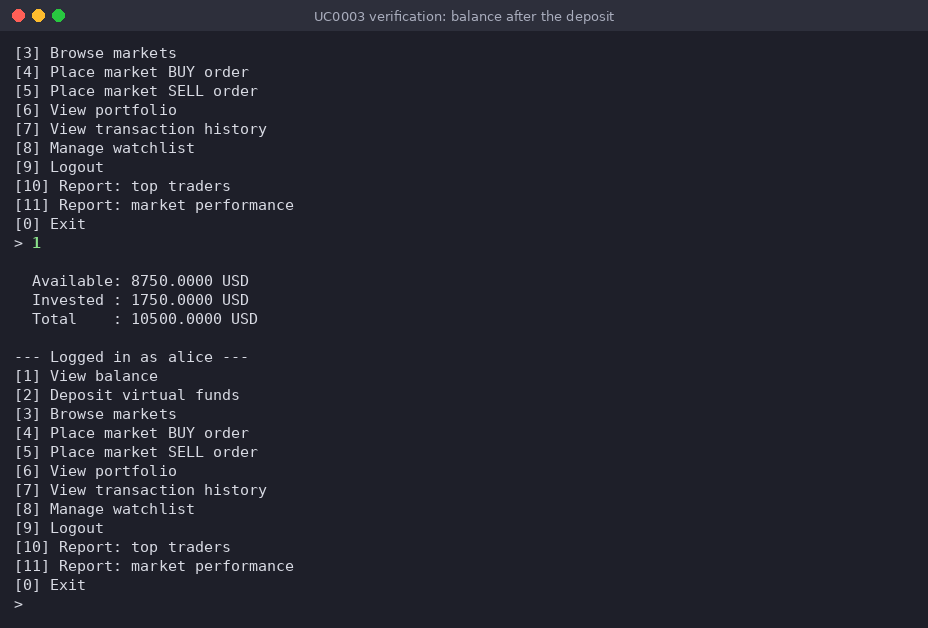
Right after the deposit the Trader chooses [1] View balance (function
ShowBalance), which runs ($1 = user id):
SELECT available_balance, invested_balance FROM users WHERE id = $1
It prints Available: 8750.0000 USD, Invested : 1750.0000 USD,
Total : 10500.0000 USD. The available balance grew from the seed value 8250.00
by exactly the 500.00 deposited (the rejected -50 changed nothing), and
invested_balance is untouched.

How to reproduce
./eduberza -init
./eduberza
# [2] Login: alice / test123
# [2] Deposit virtual funds: -50   -> Invalid amount.
# [2] Deposit virtual funds: 500   -> Deposited 500.0000 USD.
# [1] View balance                 -> Available: 8750.0000 USD
All four screenshots come from one real run of exactly these inputs.
Source code
server/account.go — Deposit, and ShowBalance used for the verification:
// ShowBalance prints the logged-in user's balances.
func ShowBalance(s *Session) {
	var avail, invested float64
	err := db.DB.QueryRow(
		`SELECT available_balance, invested_balance FROM users WHERE id = $1`,
		s.UserID,
	).Scan(&avail, &invested)
	if err != nil {
		fmt.Println("Error:", err)
		return
	}
	fmt.Printf("\n  Available: %.4f USD\n", avail)
	fmt.Printf("  Invested : %.4f USD\n", invested)
	fmt.Printf("  Total    : %.4f USD\n", avail+invested)
}

// Deposit - UC0003
// Transactional: updates users.available_balance and inserts a ledger row.
func Deposit(s *Session) {
	fmt.Println("\n-- Deposit virtual funds --")
	amtStr := prompt("Amount (USD): ")
	amt, err := strconv.ParseFloat(amtStr, 64)
	if err != nil || amt <= 0 {
		fmt.Println("Invalid amount.")
		return
	}

	tx, err := db.DB.Begin()
	if err != nil {
		fmt.Println("Error:", err)
		return
	}
	defer tx.Rollback()

	if _, err := tx.Exec(
		`UPDATE users
		    SET available_balance = available_balance + $1,
		        updated_at        = now()
		  WHERE id = $2`,
		amt, s.UserID,
	); err != nil {
		fmt.Println("Error:", err)
		return
	}
	if _, err := tx.Exec(
		`INSERT INTO transactions (user_id, type, amount, currency, description)
		 VALUES ($1, 'deposit', $2, 'USD', 'Virtual deposit')`,
		s.UserID, amt,
	); err != nil {
		fmt.Println("Error:", err)
		return
	}
	if err := tx.Commit(); err != nil {
		fmt.Println("Error:", err)
		return
	}
	fmt.Printf("Deposited %.4f USD.\n", amt)
}
Attachments (5)
- uc0003_1_2_deposit.png (46.2 KB ) - added by 4 weeks ago.
- uc0003_3_6_deposited.png (54.3 KB ) - added by 4 weeks ago.
- uc0003_4a_invalid.png (53.6 KB ) - added by 4 weeks ago.
- uc0003_4a_invalid.2.png (53.6 KB ) - added by 4 weeks ago.
- uc0003_verify_balance.png (54.6 KB ) - added by 4 weeks ago.
Download all attachments as: .zip